Bridging the Cinematic Gap
NVIDIA has historically strived to provide the graphics performance necessary for game developers to create realistic worlds where lighting, reflections, and shadows behave naturally. From programmable shaders in GeForce 3 (2001) to CUDA in GeForce 8800 GTX (2006), real-time ray tracing in GeForce RTX 2080 Ti (2018), and path tracing with neural shaders in GeForce RTX 5090 (2025), NVIDIA has achieved substantial architectural innovations and computational power increases.
However, the rendering power available for a 16-millisecond game frame is a fraction of what is used for photorealistic VFX frames in Hollywood movies, which can take minutes to hours to render. Real-time rendering cannot close the gap to photorealism through brute force alone.
DLSS was initially released in 2018 as an AI technology to boost performance, first through resolution upscaling and later by generating entirely new frames. It is now integrated into over 750 games and has become an industry standard. DLSS 4.5, announced at this year’s CES, uses AI to draw 23 out of 24 pixels on the screen. DLSS has evolved beyond merely enhancing performance to transforming the visual fidelity of games.
How DLSS 5 Works
While video AI models have rapidly developed the ability to generate photorealistic pixels, these often operate offline, produce discrete content for each new prompt, and can be challenging to control precisely and predict reliably. In gaming, pixels must be deterministic, delivered in real time, and closely aligned with the game developer’s 3D world and artistic intent.
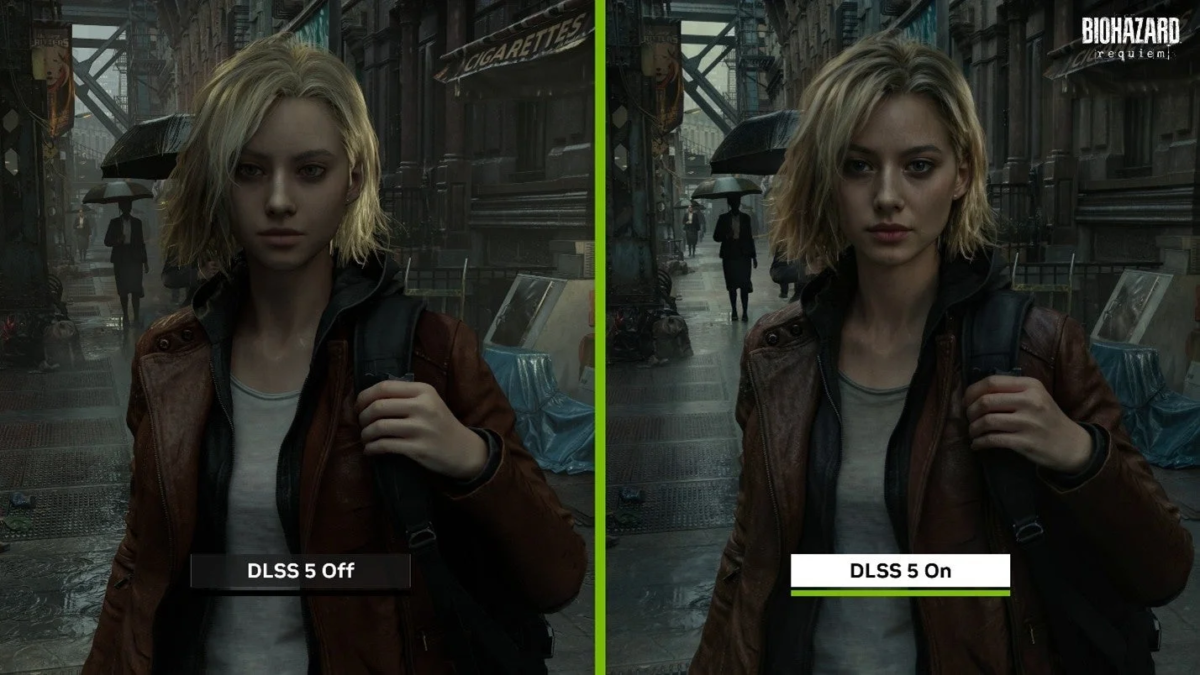
DLSS 5 takes the game’s color information and motion vectors from each frame as input. It then uses an AI model to apply photorealistic lighting and materials to the scene, ensuring fidelity to the original 3D content and consistency across frames. DLSS 5 operates in real time at resolutions up to 4K, facilitating smooth and interactive gameplay.
The AI model is trained end-to-end to comprehend complex scene semantics such as characters, hair, fabric, and translucent skin, as well as environmental lighting conditions like front light, back light, and overcast skies, by analyzing just a single frame. Based on this advanced understanding, DLSS 5 generates visually intricate images that maintain the original scene’s structure and semantics, while handling complex elements such as subsurface scattering on skin, the subtle sheen of fabric, and the interaction of light and material on hair.
DLSS 5 provides game developers with granular control over intensity, color grading, and masking. This allows artists to determine where and how enhancements are applied to preserve each game’s unique aesthetic. Integration is seamless, utilizing the same NVIDIA Streamline framework as existing DLSS and NVIDIA Reflex technologies.
Availability and Developer Support
DLSS 5 is anticipated to be supported by leading publishers and game developers, including Bethesda, Capcom, Hotta Studio, NetEase, NCSOFT, S-GAME, Tencent, Ubisoft, and Warner Bros. Games.
Todd Howard, Studio Head and Executive Producer at Bethesda Game Studios, commented on the impressive visual transformation of “Starfield” with DLSS 5. Jun Takeuchi, Executive Producer and Managing Corporate Officer at Capcom, highlighted how DLSS 5 is a significant step towards enhancing visual expression in games like “Resident Evil,” drawing players deeper into the experience. Charlie Guillemot, Co-CEO of Vantage Studios, noted that DLSS 5 enables the creation of worlds developers have always aspired to build in titles such as “Assassin’s Creed Shadows.”
DLSS 5 is slated for integration into numerous games, including:
-
AION 2
-
Assassin’s Creed Shadows
-
Black State
-
CINDER CITY
-
Delta Force
-
Hogwarts Legacy
-
Justice
-
NARAKA: BLADEPOINT
-
NTE: Neverness to Everness
-
Phantom Blade Zero
-
Resident Evil Requiem
-
Sea of Remnants
-
Starfield
-
The Elder Scrolls IV: Oblivion Remastered
-
Where Winds Meet
DLSS 5 is scheduled for release in the Fall.
For more information, viewers can watch Jensen Huang’s GTC keynote and explore various sessions:
Additional information about NVIDIA is available on their official website: