- LCC’s Rapid Growth and the Unaddressed “Baggage Problem”
- The “7kg Wall” Imposed by Major LCCs
- Excess Baggage Fees Erase the Benefits of “Low-Cost Airfares”
- The Core Issue: “Volume” Causes Over-Restriction
- MIGARU Enables “LCC Carry-on Limit Packing”
- The Origin of MIGARU: “Addition and Subtraction”
- Product Overview
- Makuake Project Overview
- Development Story
- Data Sources
LCC’s Rapid Growth and the Unaddressed “Baggage Problem”
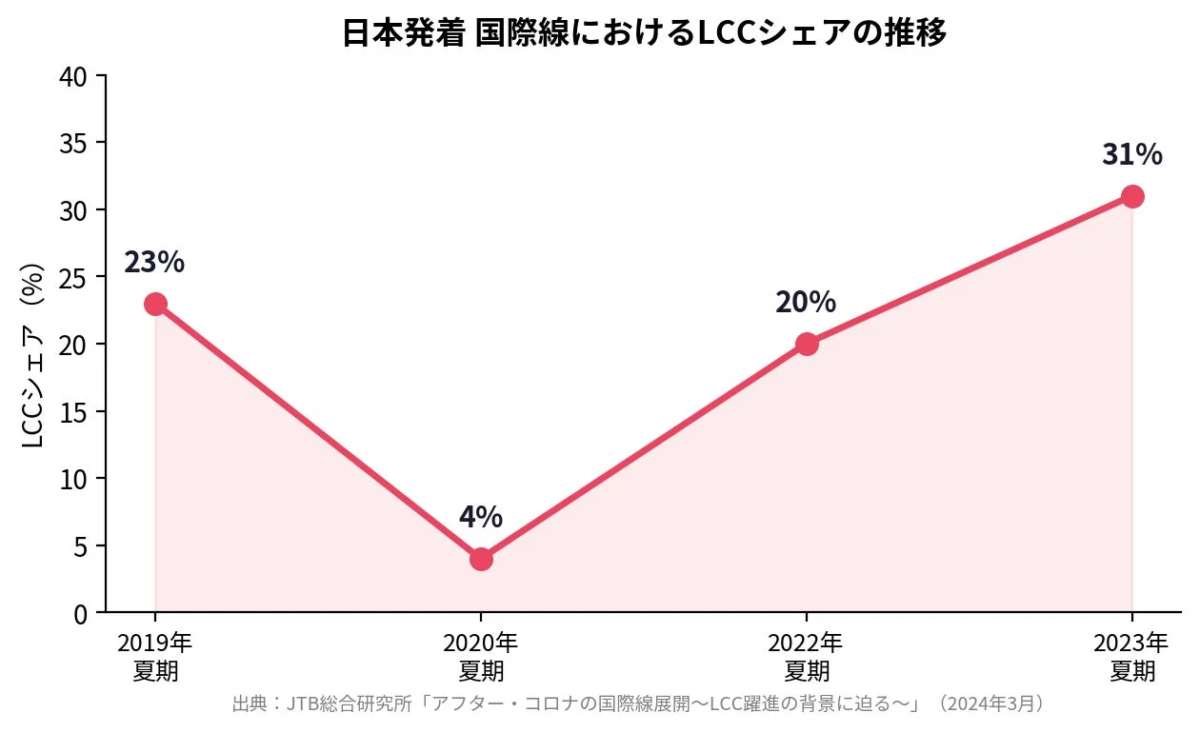
The LCC sector is significantly expanding its presence in the Japanese aviation market. According to analysis by JTB Tourism Research & Consulting Co., the LCC share of international flights to and from Japan reached 31% in Summer 2023, a substantial recovery exceeding the pre-COVID-19 level of 23% in Summer 2019.

(Source: JTB Tourism Research & Consulting Co. “International Flight Developments Post-COVID — Delving into the Background of LCC’s Ascent” (March 2024) https://www.tourism.jp/tourism-database/column/2024/03/lcc-after-covid/)
A survey by MyVoiceCom (April 2024, 9,557 respondents) indicated that over 30% of individuals intend to use LCCs, with this figure rising to 50% among those in their teens and twenties. This suggests LCCs are becoming a standard mode of transport, particularly among younger demographics.
(Source: MyVoiceCom “Survey on Airline Usage (5th Edition)” (April 2024) http://www.myvoice.co.jp/biz/surveys/30911/index.html)
Despite the increasing popularity of LCCs, a recurring issue for users is baggage restrictions.
The “7kg Wall” Imposed by Major LCCs
Major domestic LCCs, including Peach Aviation, Jetstar Japan, Spring Japan, ZIPAIR, and AirAsia, set a 7kg limit for carry-on baggage. This is 3kg less than the 10kg limit typically allowed by full-service carriers like ANA and JAL. This 3kg difference significantly constrains travelers’ packing.
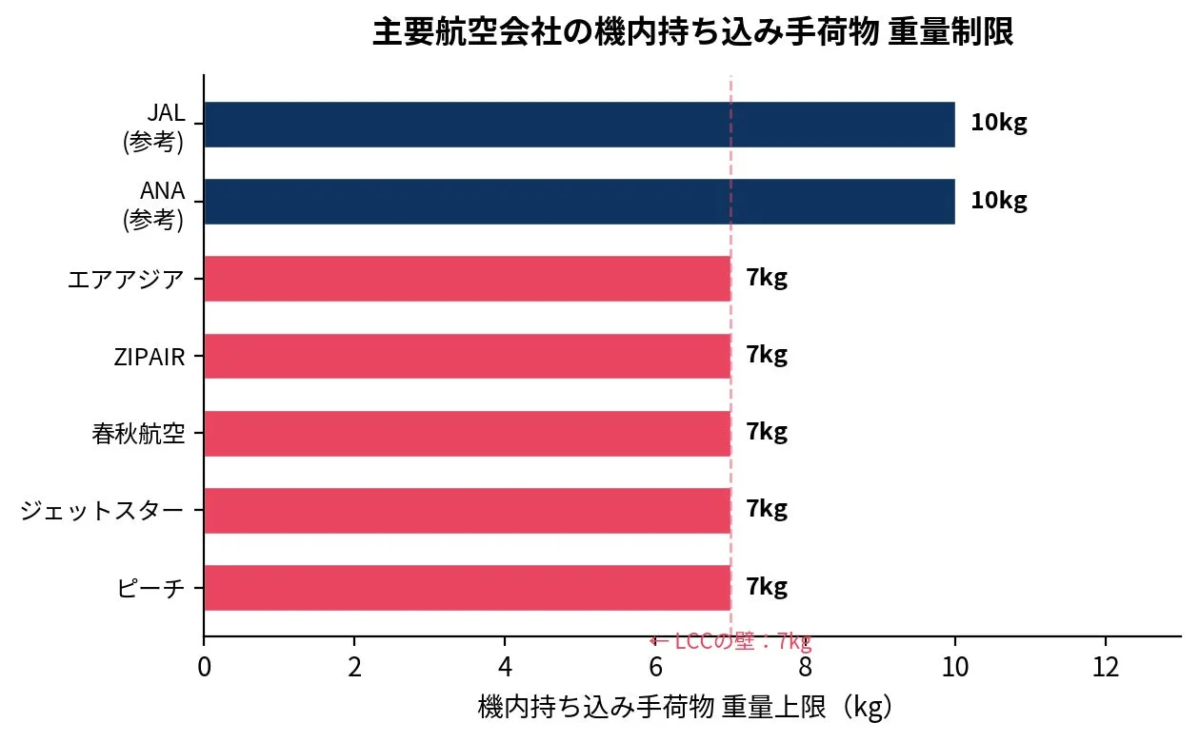
Based on information from each company’s official website as of 2025. Conditions may vary depending on fare type.
Considering that a carry-on suitcase itself weighs 2-3kg, the actual usable weight for contents is only about 4-5kg. Even for a 2-night, 3-day business trip, adding clothes, a PC adapter, and toiletries can quickly reach the limit.
Excess Baggage Fees Erase the Benefits of “Low-Cost Airfares”
Exceeding baggage limits incurs unexpected additional charges. A particular concern is that fees paid at airport counters or boarding gates on the day of travel are significantly higher compared to purchasing baggage allowance online in advance.
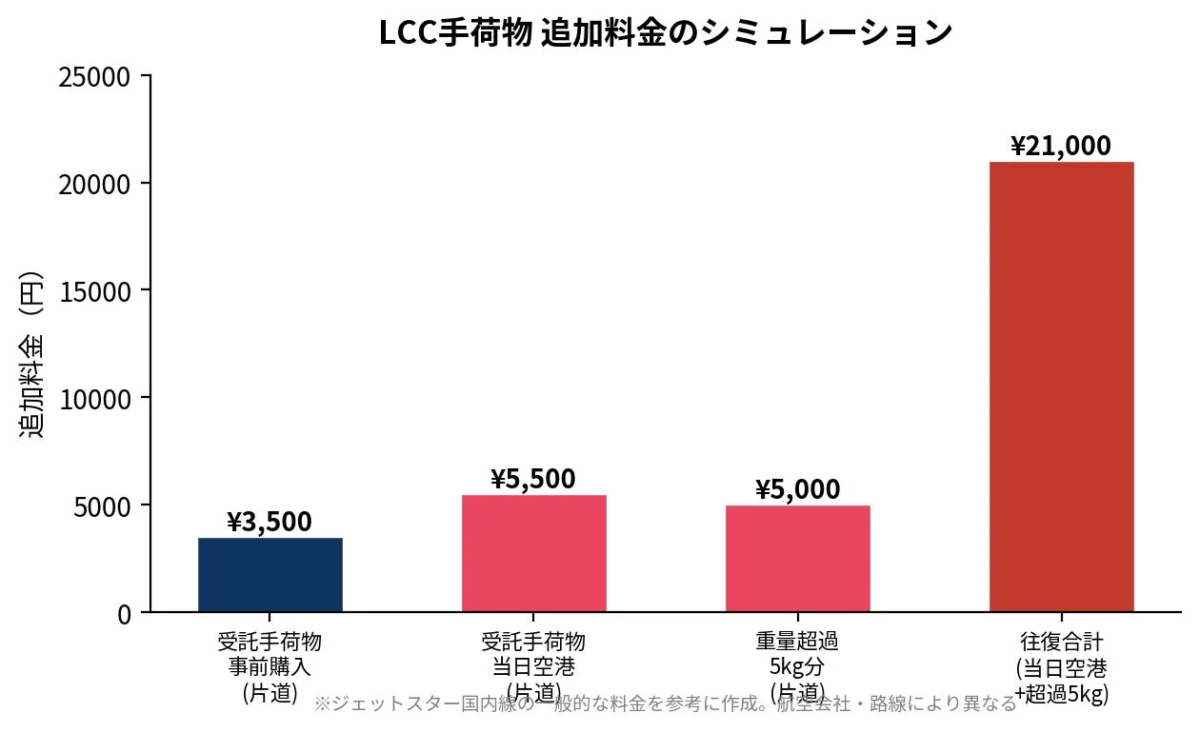
For instance, with Jetstar, adding 15kg of checked baggage costs 4,600 JPY at the airport counter and 5,500 JPY at the boarding gate. Exceeding 15kg further adds 1,000 JPY per kg, potentially reaching a total of 10,500 JPY for a boarding gate application.
(Source: Jetstar Official Website https://www.jetstar.com/jp/ja/help/articles/excess-baggage-charges-at-the-airport)
For a round trip, this could mean an additional expense of over 20,000 JPY. For a one-way low-cost flight priced around 5,000 JPY, baggage fees alone can equal the airfare. International flights can incur even higher excess fees, ranging from several thousand to over 10,000 JPY per segment depending on the route and season.
The Core Issue: “Volume” Causes Over-Restriction
Baggage weight overruns are often not due to carrying excessively heavy items, but rather because bulky clothing prevents items from fitting into the bag, necessitating additional luggage.
A single T-shirt weighs approximately 200g. Considering a 7kg weight limit, clothing should theoretically fit. However, the problem lies in volume. Five folded T-shirts can be about 10cm thick. Packing a change of clothes for three nights can quickly fill a 7kg carry-on.
Therefore, travelers are primarily contending with “bulk” rather than “weight.”
This situation exemplifies the “addition and subtraction” dilemma: the desire to pack necessary items (addition) versus the reality of insufficient space (forced subtraction). This conflict is particularly acute for LCC users.
MIGARU Enables “LCC Carry-on Limit Packing”
The fully automatic compression bag “MIGARU,” with its built-in pump, can reduce the volume of clothing by up to 90%, making it possible to pack within LCC’s strict carry-on limits.
Its usage involves just three steps:

Benefits for LCC Users:
By significantly reducing clothing volume, “previously un-packable clothes” can now fit into the same carry-on. Compressing clothing volume can help avoid the need for additional checked baggage, potentially saving thousands to over 20,000 JPY for a round trip. The combination of “low-cost airfare + MIGARU” delivers genuine cost performance.
Assuming MIGARU’s price is 12,000 JPY, this is equivalent to 1-2 round trips of LCC excess fees. For those who use LCCs more than twice a year, the cost could quickly be recouped.
Saved excess fees can be used to enjoy an extra gourmet meal or activity at the travel destination.
MIGARU Packing Examples for Popular LCC Routes:
-
Narita → New Chitose (2 nights, 3 days / Winter)
-
Normal: Down jacket + knitwear + change of clothes → High possibility of exceeding 7kg.
-
With MIGARU: Clothes compressed → Stored in carry-on bag.
-
-
Kansai → Naha (3 nights, 4 days / Summer)
-
Normal: 4 T-shirts + 3 shorts + swimwear → Barely fits.
-
With MIGARU: Compressed, securing space for souvenirs.
-
The Origin of MIGARU: “Addition and Subtraction”
Travel preparation involves two conflicting concerns: the desire to bring many items (“addition”) and the reality of limited suitcase space, forcing items to be left behind (“subtraction”). MIGARU resolves the “subtraction” problem through compression technology, freeing travelers from the “addition” dilemma.
“No more packing worries. Just pack and press.” MIGARU aims to eliminate the stress associated with the act of packing itself.
Product Overview
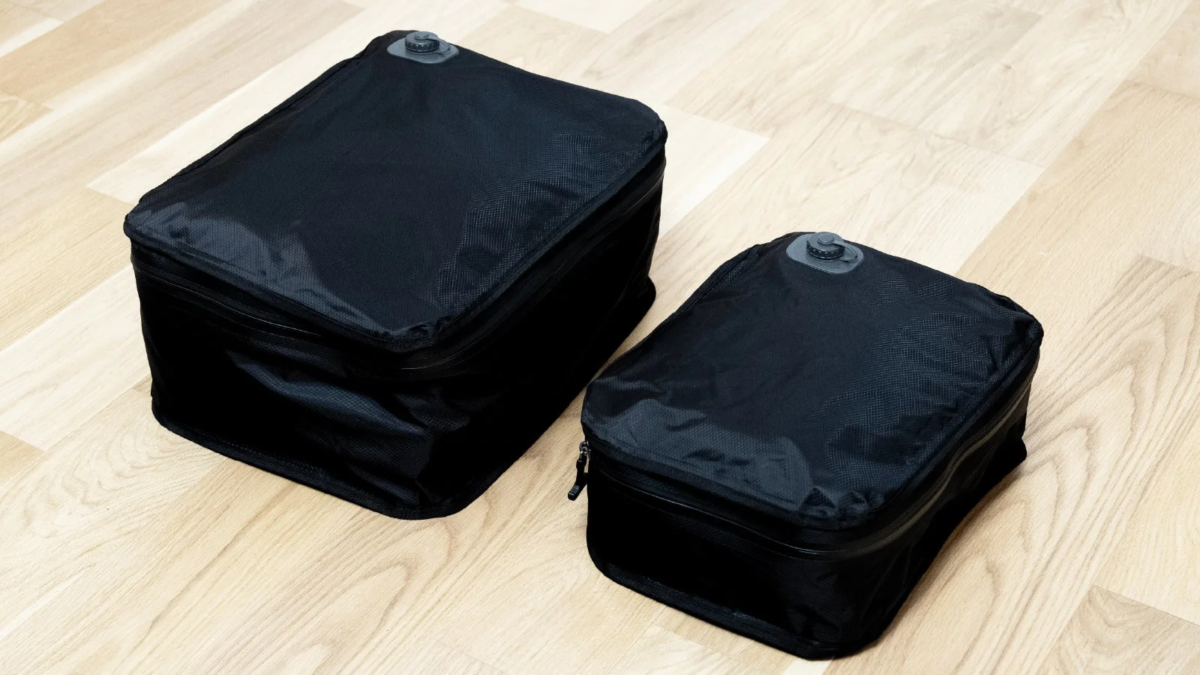
Key Features:
-
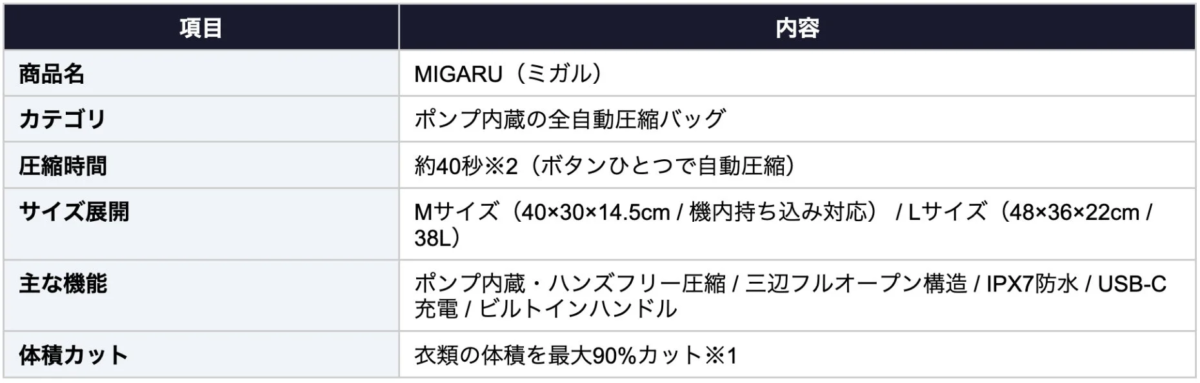
Product Name: MIGARU
-
Category: Fully automatic compression bag with built-in pump
-
Compression Time: Approximately 40 seconds (Automatic compression with a single button)
-
Size Options: M size (40×30×14.5cm / carry-on compatible) / L size (48×36×22cm / 38L)
-
Main Functions: Built-in pump, hands-free compression, three-sided full-open structure, IPX7 waterproof, USB-C charging, built-in handle
-
Volume Reduction: Up to 90% volume cut of clothing
*※1 Volume reduction depends on the type of clothing. ※2 Compression time may vary depending on the amount and type of clothing.
Makuake Project Overview
-
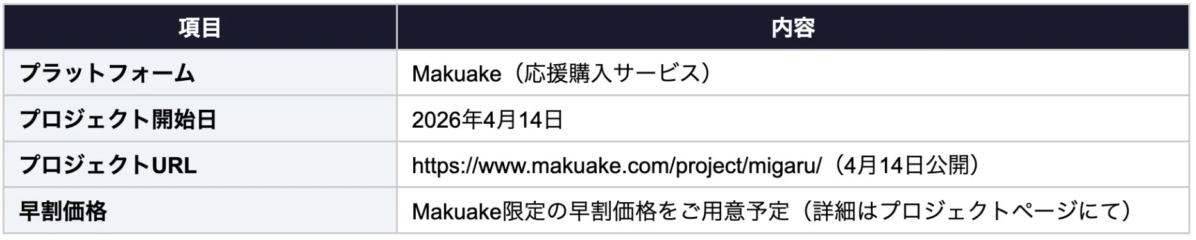
Platform: Makuake (Crowdfunding Service)
-
Project Start Date: April 14, 2026
-
Project URL: https://www.makuake.com/project/migaru/
-
Early Bird Pricing: Makuake exclusive early bird prices will be available (details on the project page).
Development Story
The development of MIGARU was inspired by the personal experience of spending “over 30 minutes worrying about packing for every business trip.” The recurring “addition and subtraction” dilemma—selecting necessary items, packing them, and then having to give up something if it didn’t fit—led to the desire to eliminate this preparation stress.
Existing compression bags were either tiring to use manually or required cumbersome external pumps. The idea for MIGARU emerged in 2025 upon encountering a small electric pump at an exhibition: “Could this be built into a bag?” Overcoming several technical challenges, including pump miniaturization, achieving IPX7 waterproof performance, and ensuring durability for repeated use, led to MIGARU’s completion.
Mami Aoki, Representative Employee of G.K. onigiri, stated, “Every time I traveled with an LCC, I found myself repacking at the airport or paying extra fees. Although I used compression bags, conventional manual ones had their limits. We realized that ‘seriously’ compressing volume with an electric pump could overcome the bulk barrier—that was the design philosophy behind MIGARU.”
Data Sources
- JTB Tourism Research & Consulting Co. “International Flight Developments Post-COVID — Delving into the Background of LCC’s Ascent” (March 2024)
https://www.tourism.jp/tourism-database/column/2024/03/lcc-after-covid/ - MyVoiceCom “Survey on Airline Usage (5th Edition)” (April 2024, 9,557 respondents)
http://www.myvoice.co.jp/biz/surveys/30911/index.html - Official websites of various airlines (Peach Aviation, Jetstar Japan, Spring Japan, ZIPAIR, AirAsia, ANA, JAL) baggage regulations (as of 2025)
- Jetstar “Excess Baggage Charges at the Airport”
https://www.jetstar.com/jp/ja/help/articles/excess-baggage-charges-at-the-airport