Low Power SRAM Market Expected to Double by 2035, Fueled by IoT and Digital Infrastructure
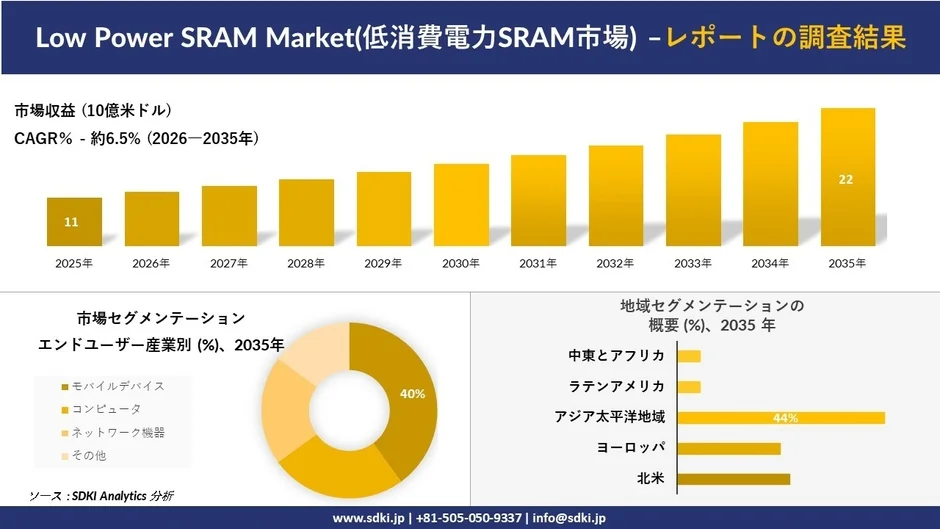
SDKI Analytics has released a comprehensive study on the “Low Power SRAM Market,” forecasting significant growth over the period from 2026 to 2035. The market, valued at approximately USD 1.1 billion in 2025, is projected to reach around USD 2.2 billion by 2035, demonstrating a compound annual growth rate (CAGR) of approximately 6.5% during this timeframe.

Market Overview
The widespread adoption of the Internet of Things (IoT) is a primary driver for the Low Power SRAM market. IoT applications, including industrial automation, healthcare wearables, smart homes, and connected cars, are establishing themselves as foundational elements of global digital infrastructure. This expansion necessitates embedded memory solutions optimized for low energy consumption. SRAM’s ability to minimize leakage current directly addresses the battery life constraints inherent in IoT devices. Research indicates that IoT devices utilizing optimized SRAM can achieve a 32-48% reduction in power consumption compared to those using DRAM.
However, the market faces challenges, particularly concerning supply chain vulnerabilities. A significant reliance on imported raw materials creates supply chain risks. Disruptions in raw material supply can lead to production delays and increased manufacturing costs. For instance, Japan heavily depends on imported raw materials for semiconductor production, with Taiwan serving as its largest semiconductor supplier, accounting for approximately 60% of Japan’s total semiconductor imports. Analysts note that global semiconductor shortages have led to average lead times extending to 25-30 weeks.
Recent Developments
Recent activities within the Low Power SRAM market include:
-
June 2025: Marvell unveiled its 2nm custom SRAM, designed to reduce standby power by up to 66%. This development aims to optimize energy efficiency for AI infrastructure chips while also reducing die area and enhancing performance.
-
September 2025: Renesas Electronics Corporation introduced the RA0L1 microcontroller, which integrates low-power memory, including 16KB of SRAM. This product is engineered to enable efficient data retention, ultra-low standby current, and reduced energy consumption for battery-powered applications.
Market Segmentation
The Low Power SRAM Market is segmented by end-user industry into mobile devices, computers, network equipment, and others. Mobile devices are anticipated to be the leading sub-segment, projected to hold a 40% market share by 2035. This dominance is attributed to the critical role of low-power SRAM in achieving energy-efficient memory operations, extending battery life, and supporting high-performance applications such as gaming, AI-powered applications, and multimedia. The growth in 5G mobile subscriptions, which reached 1.75 billion in 2023, further underscores the demand for high-performance mobile applications.
Regional Outlook
Europe
The European market for Low Power SRAM continues to grow at a steady pace, driven by the increasing adoption of IoT, investments in semiconductor research and development, and national energy efficiency regulations. Low-power SRAM is an essential component for IoT sensors and edge devices that require extremely low energy consumption. The number of connected IoT devices in Europe is expected to increase by 13.5% in 2025, reaching approximately 40 billion by 2030.
Japan
Japan’s Low Power SRAM market is experiencing rapid expansion, supported by government-led semiconductor investments, strategic R&D initiatives, and growing demand in the IoT and automotive sectors. Semiconductors are recognized as a critical resource for economic security in Japan, leading the government to plan an investment of JPY 2 trillion to strengthen domestic semiconductor production capacity. This funding is intended to foster the development of advanced memory technologies, including low-power SRAM, and enhance supply chain resilience.
Key Market Players
Prominent players in the global Low Power SRAM Market include:
-
Infineon Technologies (Cypress Semiconductor)
-
NXP Semiconductors
-
Microchip Technology
-
onsemi (ON Semiconductor)
-
ISSI (Integrated Silicon Solution Inc.)
Top players in the Japanese market are:
-
Renesas Electronics
-
Fujitsu Semiconductor Memory Solution
-
Toshiba Electronic Devices & Storage
-
Sony Semiconductor Solutions
-
Rohm Semiconductor
Further Information
For more detailed insights and to access the full report, please visit:
About SDKI Analytics
SDKI Analytics provides reliable and detailed market research and insights. The company focuses on researching and delivering in-depth market reports on growth indicators, challenges, trends, and the competitive landscape, aiming to transform clients’ businesses toward maximum growth and success.
Contact Information
-
Phone: +81 50 50509337 (9:00-18:00 JST, excluding weekends and holidays)
-
URL: https://www.sdki.jp/