
A New Habit: Incorporating Tongue Care into Finishing Brushing
Oral Care Should Be Habitual from Childhood!
Similar to general body care, oral care is significantly influenced by lifestyle habits formed during childhood. Therefore, it is recommended to start habituating children to oral care as early as possible. Since it is challenging for children to be aware of this themselves, it is important for parents and guardians to first adjust their own understanding.
In an era of living to 100 years, not only general physical health but also the parts around the face, such as the ears, eyes, and mouth, are crucial for living. Oral care, which is essential for the act of “eating” directly linked to survival, is particularly important. In oral care, there is growing interest not only in dental health but also in the care of the “tongue,” which supports “speaking,” “breathing,” and “swallowing.” Regarding the tongue, “tongue coating,” a buildup of debris on the tongue, is said to be a cause of bad breath, and many experts emphasize the importance of daily care.
For Growing Children’s Delicate Tongues, Gentle Oral Care with a “Dedicated Tongue Brush”!
While tooth brushing is a daily habit, many households do not yet prioritize “tongue care.” In recent years, “tongue coating,” which adheres to the surface of the tongue, has garnered attention as one of the primary causes of bad breath, and many experts emphasize the importance of tongue care in considering children’s oral hygiene.
However, many parents and guardians believe that simply “lightly scrubbing the tongue with a toothbrush” is sufficient. In reality, a child’s tongue mucous membrane is softer and much more delicate than an adult’s. Brushing vigorously with the hard bristles of a toothbrush can cause excessive irritation, leading to pain or discomfort.
Therefore, it is considered desirable to use a brush specifically designed for the tongue for cleaning. Tongue brushes are structured to gently clean the tongue’s surface, efficiently removing tongue coating adhering between the lingual papillae while minimizing the burden on the mucous membrane.
Conversely, over-brushing the tongue is also discouraged. It is often stated that once a day, gently stroking from the back to the front a few times without applying force, is sufficient. Establishing proper tongue care habits with the correct tools from childhood can not only prevent bad breath but also foster an interest in oral hygiene. By having parents and guardians understand the correct knowledge that “a tongue brush is for the tongue, not a toothbrush,” and by making “tongue brushing” a daily habit, just like tooth brushing, it can contribute to creating a healthy oral environment for children. It is important to note that tongue conditions vary among individuals. If you have concerns, such as tongue coating not thinning even after using a tongue brush, it is advisable to consult a dental professional or other expert rather than making your own judgment.
Check Your Child’s Tongue Care at Home!
-
Brushing teeth daily but not brushing the tongue
-
Brushing the tongue with a toothbrush
-
Believing that scrubbing hard will remove dirt
-
Never used a tongue brush
-
Child’s tongue sometimes appears whitish
-
Bad breath persists even after brushing teeth
If two or more items apply, it may be time to review your tongue care methods. A child’s tongue is more delicate than an adult’s. Why not incorporate gentle care using a dedicated tongue brush in addition to daily tooth brushing? Appropriately removing tongue coating and maintaining a good oral environment can reduce bad breath, sustain immunity, and lead to the prevention of various diseases. Furthermore, keeping the tongue surface clean can enhance the ability to taste food, making meals more enjoyable. Incorporate tongue brushing using the dedicated tongue brushes “Tongue Smoother W-1 PREMIUM” and “Tongue Smoother W-1 PREMIUM for Kids” into your family’s daily health routine for bad breath prevention and overall health management, ensuring healthy and comfortable days.

How to Use the Tongue Smoother W-1 PREMIUM
Usage:
- Apply water to the smoother, place it on the tongue, and gently brush in a stroking motion.
- Use the convex side of the smoother to clean the arched central part of the tongue.
- Use the concave side to clean the sides and raised parts of the tongue. (The side with three dots (∴) on the handle is the concave side).
- Rinse lightly with running water and repeat a few times. (The dirt captured by the smoother will be visible.)
- The brushing is complete when no more dirt adheres to the smoother after several strokes.
- After use, rinse off dirt with running water.
- Store in a cool, dry place.
Replacement Period:
Replace with a new one after 1 to 2 months of use. However, if accumulated dirt becomes noticeable, replace it sooner regardless of the period.
For Children Who Gag:
Start with the shallower part of the tongue. Gently move the brush from the back of the tongue to the front 1 to 3 times while slowly breathing through the nose, which can help ease the gag reflex. Begin with short durations until accustomed, then gradually increase the time.
Product Introduction
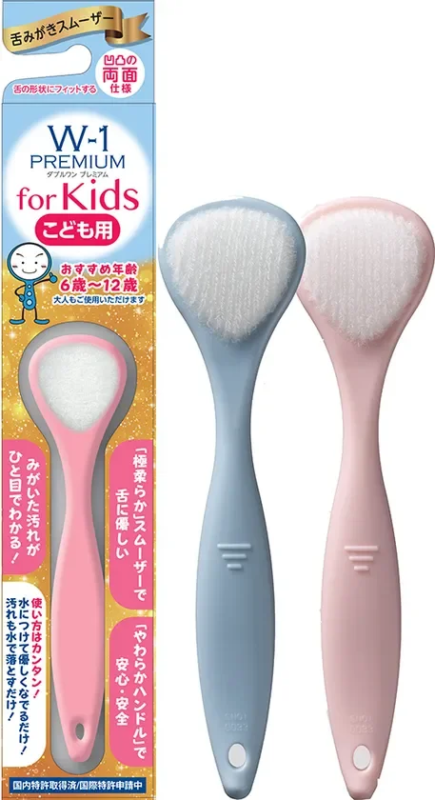
Children’s Tongue Smoother W-1 PREMIUM for Kids
-
Colors: 2 colors
-
Suggested Retail Price: 638 JPY (tax included) each
-
The handle features a soft resin material, ensuring safe use for children.
-
This tongue brush offers a gentle and comfortable feel on the tongue, even among the W-1 series.
-
Hook-shaped ultra-fine nylon fibers penetrate between the lingual papillae from all angles, trapping tongue coating.
Adult Tongue Smoother W-1 PREMIUM

-
Colors: 4 colors
-
Suggested Retail Price: 638 JPY (tax included) each
-
This is an adult tongue brush.
-
Approximately 8,000 specially processed ultra-fine nylon fibers are on one side!
-
Hook-shaped ultra-fine nylon fibers penetrate between the lingual papillae from all angles, trapping tongue coating.
For all SHIKIEN products, please visit the SHIKIEN Online Shop:
https://store.w-1-shikien.co.jp/