Global High-Rate Lithium-Ion Polymer Battery Market Overview
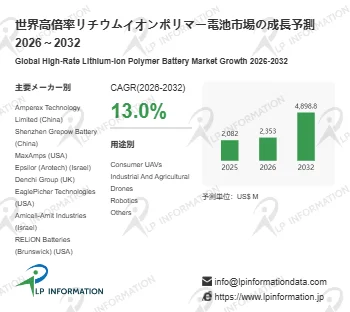
The global market for high-rate lithium-ion polymer batteries is experiencing robust growth, with projections indicating a substantial increase in market size over the next decade. According to a report by LP Information, the market, valued at $2,082 million in 2025, is expected to expand to $2,353 million in 2026 and further reach $4,898.8 million by 2032. This growth represents a compound annual growth rate (CAGR) of 13.0% from 2026 to 2032.

Product Definition and Characteristics
High-rate lithium-ion polymer batteries are soft-pack lithium-ion batteries specifically engineered for high-rate charge and discharge applications. Key features include a flexible pouch structure, high instantaneous discharge current, stable output characteristics, and easily customizable cell shapes. These batteries are primarily utilized in consumer drones, industrial and agricultural drones, robots, model equipment, and other mobile power systems that require lightweight and high-power solutions.
The current market demand is fueled by the need for extended flight times in drones, enhanced motion performance in robots, and the proliferation of high-power portable devices. Compared to conventional lithium-ion batteries, high-rate variants emphasize stable discharge plateaus, controlled temperature rise, consistent safety, and custom battery pack designs. Leading companies in this sector include Amperex Technology Limited, Shenzhen Grepow Battery, and MaxAmps, with competition focusing on rate performance, energy density, reliability, delivery responsiveness, and technical support.
Market Dynamics and Leading Manufacturers
The expansion of the low-altitude economy, industrial drones, agricultural spraying, inspection robots, and high-mobility robots is anticipated to drive future market growth. As terminal equipment increasingly demands long operating times, high instantaneous output, lighter weight, and enhanced safety, battery manufacturers are challenged to advance material systems, lamination processes, thermal management, battery pack integration, and protection designs. Companies capable of rapid customization and stable mass production are expected to secure high-value projects.
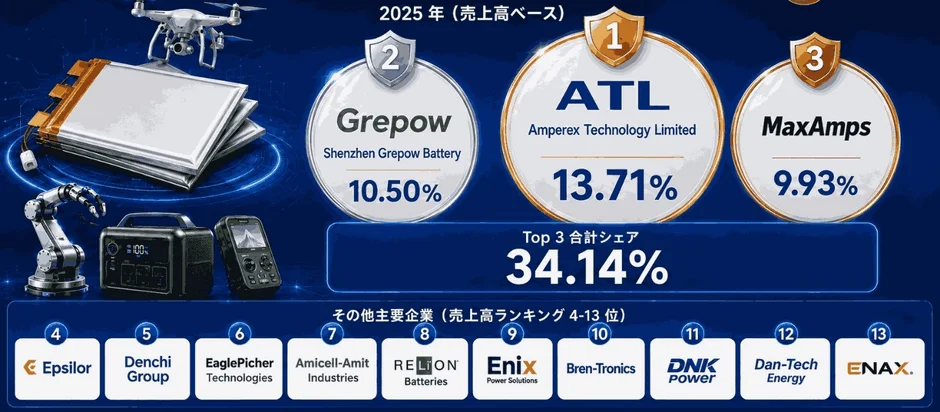
In 2025, the global high-rate lithium-ion polymer battery market saw Amperex Technology Limited, Shenzhen Grepow Battery, and MaxAmps as the top three manufacturers, collectively holding approximately 34.14% of the market share.
Industry Chain Analysis
Upstream
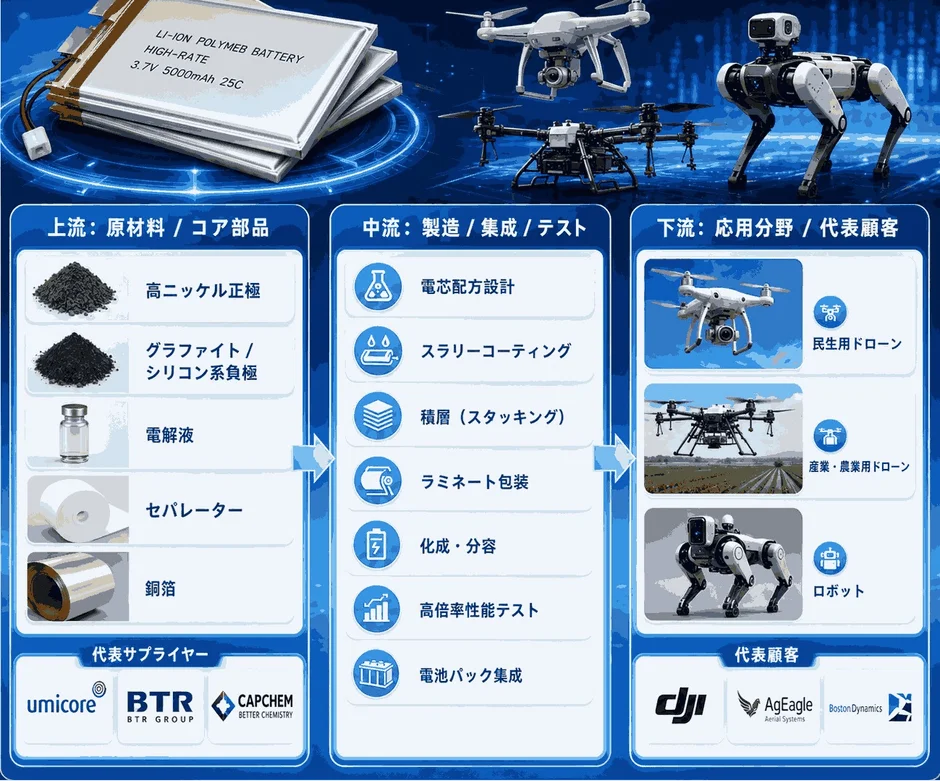
The upstream segment involves key materials such as high-nickel cathode materials, graphite or silicon-based anode materials, electrolytes, separators, and copper foil. Major suppliers include Umicore, BTR, and Capchem. These materials directly influence the rate discharge performance, energy density, internal resistance, thermal stability, and cycle life, thereby affecting safety, cost, and quality consistency in high-power applications.
Midstream
The midstream segment focuses on cell formulation design, slurry coating, lamination, soft-pack sealing, formation and grading, high-rate performance testing, and battery pack integration. Manufacturers must comprehensively manage electrode uniformity, internal resistance, sealing reliability, temperature rise, and safety protection. Process stability directly impacts discharge characteristics, lifespan, yield, and unit cost.
Downstream
Downstream demand is concentrated in consumer drones, industrial and agricultural drones, and robotics, with prominent customers including DJI, AgEagle Aerial Systems, and Boston Dynamics. These devices prioritize instantaneous output, lightweight design, stable current supply, and safety redundancy. High-rate lithium-ion polymer batteries contribute to improving payload capacity, acceleration response, work efficiency, and operational stability in complex environments.
Growth Opportunities and Risks
Primary growth drivers include the expanding applications of drones and robots. Consumer drones require extended flight times and strong power response, while industrial inspection, agricultural spraying, and robotics applications demand stable power under high loads and frequent operations. This shift is driving demand for high-rate, lightweight, and customizable batteries, accelerating the replacement of conventional batteries with high-performance soft-pack alternatives.
Key inhibiting factors involve the challenge of balancing high-rate performance with safety, longevity, and cost. High-current discharge can lead to significant temperature increases, internal resistance losses, and cell-to-cell variations, necessitating high standards for materials, lamination processes, sealing quality, and protection circuits. Challenges in yield management and certification periods could potentially constrain mass production expansion and profitability.
The future direction points towards simultaneous advancements in higher power output, lighter weight, and greater customization. Customers are increasingly prioritizing not only capacity but also discharge rate, weight, dimensions, heat dissipation, communication protection, and battery pack compatibility. Companies equipped with optimized materials, soft-pack structural design, rapid prototyping capabilities, and stable quality control are expected to enhance their competitive advantage in drone, robot, and specialized applications.
Report Chapters Summary
The “Global High-Rate Lithium-Ion Polymer Battery Market Growth Forecast 2026-2032” report provides a comprehensive analysis across 14 chapters:
-
Chapter 1: Introduces the report scope, including product definition, statistical years, research objectives, methodology, data sources, economic indicators, and policy factor impacts.
-
Chapter 2: Details the global market size, covering product classification, application scope, sales volume, revenue, price, market share, and other key indicators.
-
Chapter 3: Focuses on major competitive trends in the global market, presenting key companies’ sales, revenue, market share, pricing strategies, product types, regional distribution, industry concentration, new entrants, M&A activities, and production capacity expansion.
-
Chapter 4: Analyzes the global market size by volume, revenue, and growth rates across key regions.
-
Chapter 5-8: Provide detailed information on industry size, sales volume, and revenue for high-rate lithium-ion polymer batteries in the Americas, Asia-Pacific, Europe, and the Middle East & Africa regions, respectively.
-
Chapter 9: Analyzes industry trends, drivers, challenges, and risks.
-
Chapter 10: Investigates raw materials, suppliers, production costs, manufacturing processes, and related supply chains.
-
Chapter 11: Studies sales channels, distributors, and downstream customers.
-
Chapter 12: Forecasts the global market size by region and product type based on sales, revenue, and other relevant indicators.
-
Chapter 13: Presents detailed information on key manufacturers, including basic information, product specifications, applications, sales volume, revenue, pricing, gross profit margins, main businesses, and recent developments.
-
Chapter 14: Contains the research findings and conclusions.
For more details on the report or to request a free sample, please visit:
https://www.lpinformation.jp/reports/797038/high-rate-lithium-ion-polymer-battery
About LP Information
LP Information is a leading global provider of industry intelligence and market strategy support. The company offers comprehensive market trend analysis reports and overviews of the latest global industry trends, providing effective support for strategic planning and official information reporting.
Contact Information:
-
Japanese Site: https://www.lpinformation.jp/
-
English Site: https://www.lpinformationdata.com/
-
Email: info@lpinformationdata.com