Global Consumer Electronics Semiconductor Chip Market Outlook
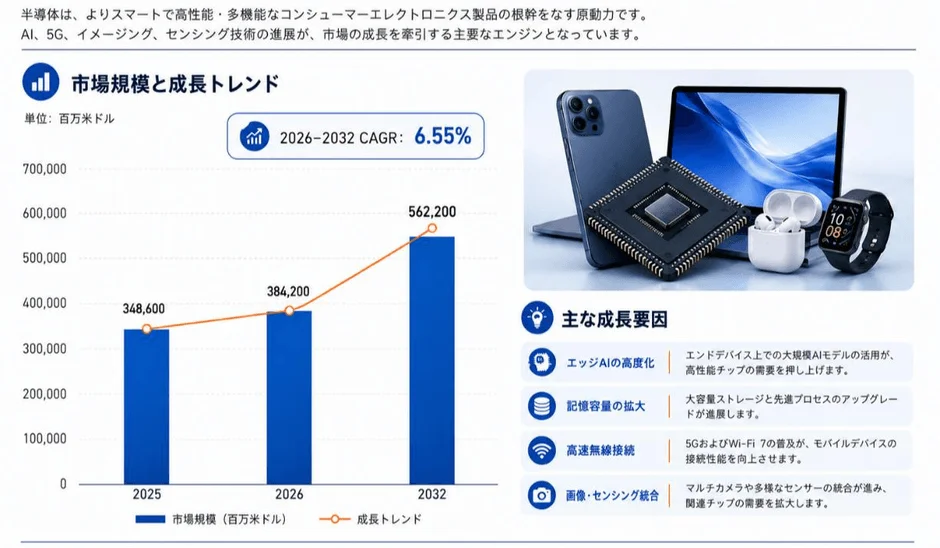
According to a report by YH Research, the global market for semiconductor chips in consumer electronics is anticipated to experience significant growth. The market size is projected to be approximately $384.2 billion in 2026, increasing from an estimated $348.6 billion in 2025. By 2032, it is forecast to reach approximately $562.2 billion, demonstrating a compound annual growth rate (CAGR) of about 6.55% from 2026 to 2032.

This market encompasses integrated circuits and semiconductor devices used in a wide array of consumer electronics, including smartphones, tablets, personal computers, televisions, game consoles, wearables, wireless audio products, smart home devices, consumer cameras, and XR devices. These chips are primarily based on silicon integrated circuits, incorporating technologies such as RF, analog, power, MEMS, CMOS image sensing, and some compound semiconductors.
Key functions include processing operating systems and applications, CPU/GPU/NPU operations, image/audio/video processing, program and data storage, cellular communication, Wi-Fi, Bluetooth, image/motion/environmental sensing, display/audio control, battery management, and power conversion. Essential product requirements emphasize high performance, low power consumption, miniaturization, high integration, low latency, stable connectivity, and cost competitiveness.
Driving Factors for Market Expansion
Market growth is supported not only by increasing unit shipments of devices but also by a rise in the semiconductor content per device. Major growth drivers include the advancement of on-device AI, expansion of memory capacity, sophisticated camera functionalities, high-speed wireless communication, enhanced sensor capabilities, and growing demands for power efficiency. While smartphones and PCs remain the largest applications, AI smartphones, AI PCs, smart glasses, healthcare wearables, smart home devices, and high-performance gaming devices are emerging as new growth areas.
From the supply side, major manufacturers are investing in advanced processes, heterogeneous computing, dedicated NPUs, low-power/high-bandwidth memory, advanced packaging, and co-design of hardware and software. The Semiconductor Industry Association reported global semiconductor sales reaching $791.7 billion in 2025, a 25.6% increase from 2024, indicating a recovery in the overall semiconductor market and expanding demand for high-performance computing.
Future growth is expected to be driven by the utilization of generative AI at the edge, larger local inference models, advancements in LPDDR and embedded storage, communication standards beyond Wi-Fi 7, multiple cameras and high-resolution image sensors, increased connectivity in smart home devices, and the commercialization of lightweight XR and AI wearables.
Competitive Landscape and Key Players
The global market sees numerous companies, yet high concentration is observed in key product segments. In the smartphone and mobile platform sector, prominent players include Qualcomm, MediaTek, Samsung Electronics, and Apple. Apple employs a vertically integrated model centered on its self-designed chips, while Qualcomm and MediaTek supply SoCs, communication technologies, and software platforms to global device manufacturers.
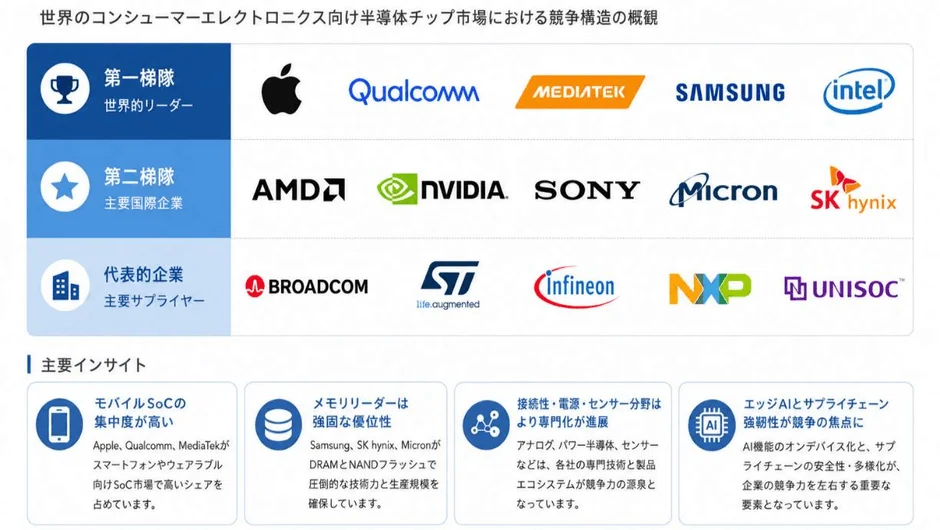
For PC and gaming computing, Intel, AMD, NVIDIA, Apple, and Qualcomm are key players. The memory sector is dominated by Samsung Electronics, SK hynix, Micron, and Kioxia. In image sensors, Sony Semiconductor Solutions, Samsung, and OmniVision are representative companies. Product information from Qualcomm, MediaTek, and Samsung confirms the ongoing integration of CPU, GPU, NPU, image processing, communication, multimedia, and display functions. Apple’s M series also highlights the importance of proprietary architecture, unified memory, and on-device AI.
Companies such as Broadcom, Texas Instruments, Infineon Technologies, NXP Semiconductors, STMicroelectronics, Renesas Electronics, Skyworks Solutions, Qorvo, Cirrus Logic, Realtek, and Novatek hold significant positions in wireless communication, analog, power management, RF front-end, audio, sensors, display drivers, and interface ICs. Sony is enhancing its CMOS image sensors with high pixel counts, stacked structures, high dynamic range, and on-chip AI functions, while Samsung, SK hynix, and Micron are improving mobile memory bandwidth, capacity, and power efficiency.
The first tier of companies possesses proprietary architectures, access to advanced processes, software ecosystems, global customer certification, and supply management capabilities. The second tier specializes in analog, power, sensors, audio, display, RF, or application-specific SoCs. Representative Chinese companies include UNISOC, Amlogic, Rockchip, Bestechic, Espressif Systems, Goodix, GigaDevice, and Will Semiconductor-related businesses.
Product Classification and Application Structure
Functionally, chips can be categorized into processing/logic chips, memory chips, analog/power chips, RF/connectivity chips, sensor/optoelectronic chips, and dedicated ICs for display, audio, and interfaces. Processing/logic products include application processors, CPUs, GPUs, NPUs, MCUs, TV SoCs, and multimedia processors. Memory products cover mobile DRAM, NAND Flash, UFS, and consumer SSD-related products.
Analog, power, and connectivity products handle charging, battery management, voltage conversion, signal processing, cellular RF, Wi-Fi, Bluetooth, and positioning functions. Sensor products include CMOS image sensors, MEMS inertial sensors, environmental sensors, ranging sensors, and biometric devices.
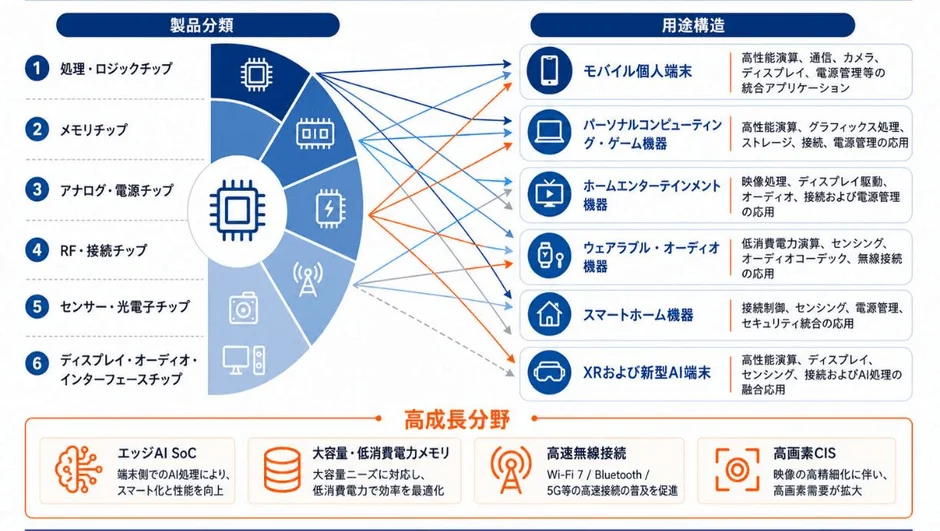
By application, products are classified into mobile personal devices, PC/gaming devices, home entertainment, wearables/audio, smart home, XR, and new AI devices. For smartphones, SoCs, LPDDR, embedded storage, RF front-ends, image sensors, and power management ICs are crucial. PC and gaming devices prioritize CPUs, GPUs, NPUs, high-speed memory, and high-speed interfaces. Televisions, projectors, and set-top boxes utilize multimedia SoCs, display control, video decoding, and communication chips. Smartwatches, earphones, and smart glasses emphasize ultra-low power MCUs, audio DSPs, sensor fusion, and compact power management.
Samsung is developing mobile processors as integrated platforms for AI, graphics, imaging, communication, and display control, while Infineon and STMicroelectronics offer a broad range of consumer semiconductors, including power, connectivity, and sensors. Future growth is expected in on-device AI processors, memory for AI smartphones/AI PCs, high-speed wireless connectivity, XR sensors, stacked CMOS image sensors, fast charging, and high-efficiency power management ICs.
Global Industry Structure and Opportunities
The global consumer electronics semiconductor industry features regional specialization across design, wafer fabrication, assembly/test, device assembly, and brand operation. The United States maintains strong competitiveness in CPUs, GPUs, mobile platforms, RF connectivity, EDA, semiconductor IP, and software ecosystems. However, the U.S. share of global semiconductor manufacturing capacity has decreased from 37% in 1990 to approximately 10% in 2022, prompting reinvestment in advanced logic, memory, analog, and advanced packaging.
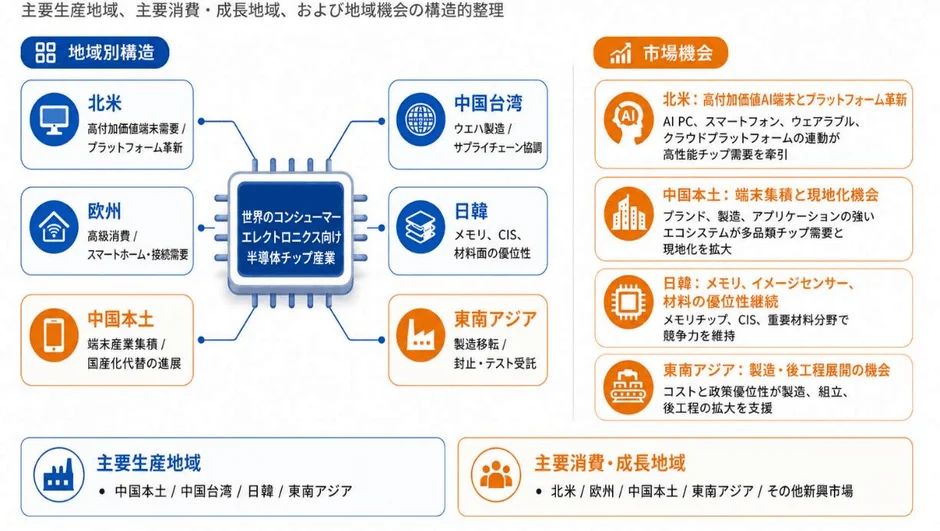
Taiwan plays a crucial role in advanced foundries, packaging, and supply chain collaboration for consumer electronics. South Korea excels in DRAM, NAND, display-related semiconductors, and mobile processors. Japan possesses high technological capabilities in CMOS image sensors, semiconductor materials, manufacturing equipment, power semiconductors, and some analog products. Europe is competitive in analog, power, MCUs, sensors, and security semiconductors, with the European Chips Act aiming to strengthen the supply chain and reduce external dependence.
Mainland China is a major manufacturing and consumption market for smartphones, televisions, smart homes, wearables, and wireless audio products. Chinese companies are expanding their product range in multimedia SoCs, IoT communication, display drivers, touch/fingerprint authentication, CMOS image sensors, NOR Flash, MCUs, and power management. Future opportunities are expected to arise from joint development with device brands, utilization of mature processes, local supply chain construction, smart home penetration, and edge AI adoption. Investment in electronics assembly, semiconductor packaging/testing, and related supply chains is also expanding in Southeast Asia.
Supply Chain, Barriers, and Future Changes
The upstream segment includes EDA software, processor architectures, interface IP, silicon wafers, photoresists, electronic gases, target materials, photomasks, package substrates, and leadframes. Exposure, etching, deposition, ion implantation, cleaning, measurement/inspection, and assembly/test equipment are also critical. Foundational technologies involve digital/analog circuit design, CPU/GPU/NPU architectures, RF/high-speed interfaces, memory cells, image sensor pixels, advanced processes, advanced packaging, and software optimization.
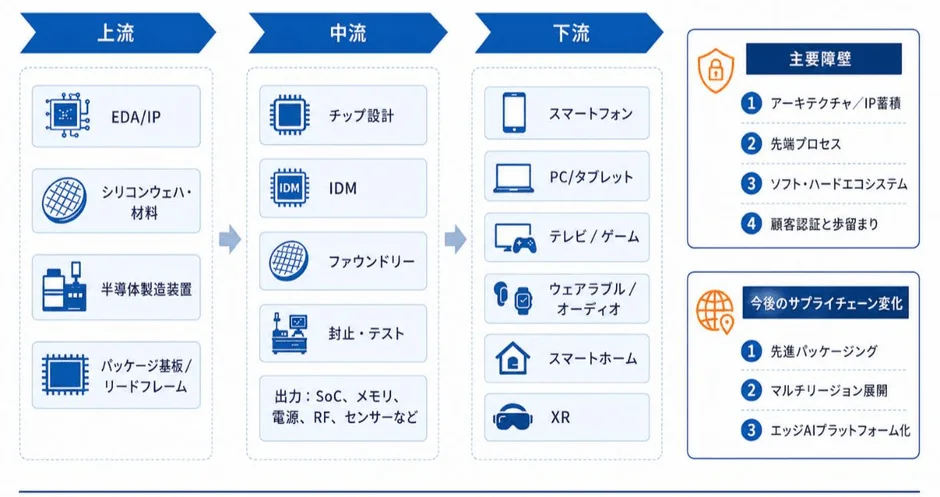
The midstream consists of fabless companies, IDMs, foundries, and OSAT companies. The downstream includes consumer electronics brands, ODMs, OEMs, module manufacturers, and distribution companies, supplying products like smartphones, PCs, televisions, game consoles, audio devices, wearables, smart home appliances, consumer cameras, and XR products.
Key barriers to entry include core IP, advanced process design, analog/RF technology, OS and development tool compatibility, customer certification, yield management, intellectual property, and continuous R&D investment. High value-added is concentrated in high-performance SoCs, CPUs, GPUs, NPUs, mobile memory, CMOS image sensors, RF front-ends, and high-performance power management products. Future trends are expected to involve manufacturing regional diversification, securing mature process capabilities, advanced packaging, multiple sourcing, and joint platform development with device manufacturers.
Countries and regions are positioning semiconductors as a strategic industry, enhancing manufacturing support, R&D funding, tax incentives, talent development, and international supply chain cooperation. Support from the U.S. and Europe extends beyond front-end manufacturing capacity to advanced packaging, research infrastructure, design, materials, and supply chain resilience. The European Commission’s Chips Act 2.0, introduced in 2026, emphasizes the design and production of advanced and mainstream chips, demand creation, and reduction of strategic dependencies.
Conversely, the industry faces challenges such as high design and tape-out costs, concentration of advanced manufacturing capabilities, complex intellectual property, long customer certification periods, short product cycles, and price pressure. Geopolitics, export controls, tariffs, memory price fluctuations, and inventory adjustments in consumer electronics could also impact supply and profitability.
Future Outlook
Over the next few years, on-device AI is anticipated to be the most significant growth theme. Semiconductor platforms will further integrate CPU, GPU, NPU, ISP, communication, storage control, security, and multimedia functions, enhancing performance-per-watt through advanced processes, Chiplets, 3D packaging, unified memory, and system power management. Smartphones and PCs are expected to lead the adoption of local generative AI, while smart glasses, earphones, watches, and home devices will see new demand for low-power AI, sensor fusion, and natural user interfaces.
This article is based on data from YH Research Co., Ltd.’s research report “Global Consumer Electronics Semiconductor Chip Top Companies Market Share and Ranking 2026.” For more information, please visit YH Research and YH Research’s main site.