Global Integrated Molding Choke Market Overview
Integrated molding chokes are high-performance surface-mount magnetic components designed for power management, power conversion, and high-frequency electronic circuits. These components are manufactured by precisely embedding pre-wound coils within metal magnetic powder or magnetic composite materials, then forming them into a single unit through high-pressure or mold molding to create a closed magnetic circuit structure. This integrated process results in extremely low leakage flux, excellent mechanical shock resistance, good heat dissipation characteristics, miniaturization, and high reliability.
In terms of performance, integrated molding chokes offer very high current tolerance and high saturation current thresholds, coupled with extremely low DC resistance, which effectively reduces power loss. Their closed magnetic circuit structure significantly suppresses electromagnetic interference, maintaining stable inductance and temperature stability across a wide temperature range. Key functions include energy storage, filtering, voltage stabilization, and current ripple suppression, making them crucial components for stable and efficient circuit operation.
Integrated molding chokes are indispensable basic components in modern electronic devices, permeating a wide range of fields such as smartphones, AI servers, electric drive systems and in-vehicle charging systems for new energy vehicles, power modules, communication base stations, industrial inverters, and various consumer electronics. They are particularly an ideal choice for applications demanding miniaturization, high current density, and low loss, such as computer CPU core power (VRM), DC-DC converters, and high-frequency switching power supplies, where they serve as a superior alternative to traditional wound inductors.
Market Size and Growth Factors
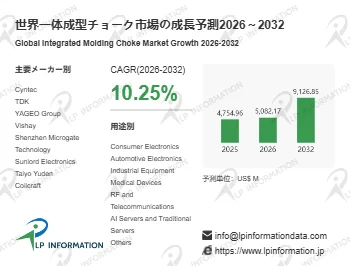
The global integrated molding choke market is poised for significant growth, transitioning into a high-growth passive component sector. The market size is projected to expand from US$4,755 million in 2025 to US$9,126.85 million in 2032, demonstrating a CAGR of 10.25% from 2026–2032. This indicates that integrated molding chokes are evolving from conventional consumer electronics components into strategic power components supporting AI servers, automotive electronics, high-density power supplies, and communication equipment.
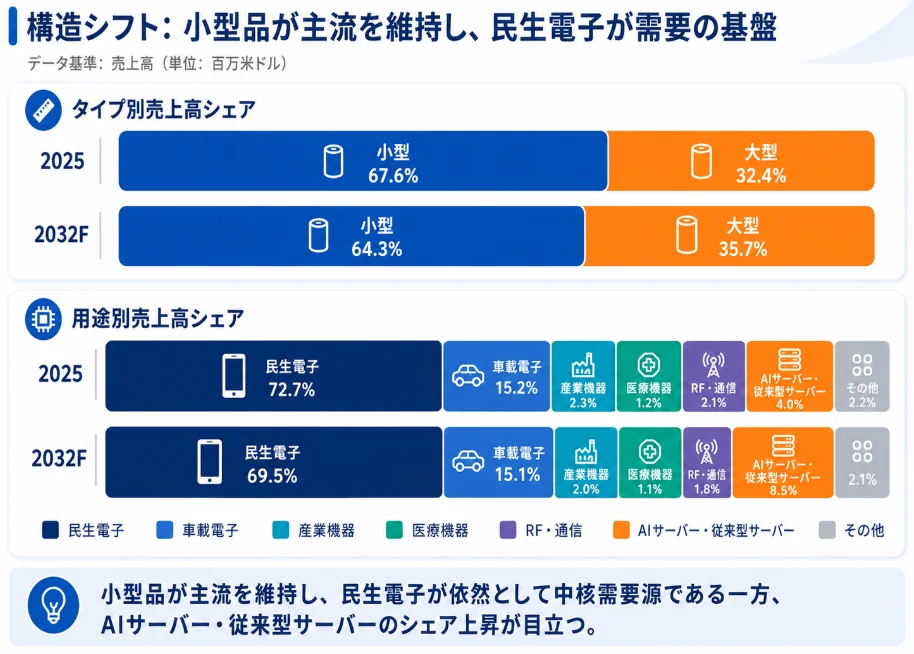
TDK, for instance, describes its SPM series as metal composite wound inductors with coils integrated into metal magnetic powder, achieving large current, low Rdc, miniaturization, excellent DC bias characteristics, and low leakage flux. While consumer electronics maintain the largest demand base, a notable trend is the increasing share of AI servers and traditional servers, rising from 4.0% to 8.5%. Murata also notes that the rapid increase in rack power density due to the proliferation of AI servers necessitates highly efficient power supply systems, aligning with the expanding demand for integrated molding chokes.

Competitive Landscape
Key players in the integrated molding choke market include Cyntec, TDK, YAGEO Group, Vishay, Shenzhen Microgate Technology, Sunlord Electronics, Taiyo Yuden, Coilcraft, Chilisin, and Sumida. Japanese companies maintain a strong presence through material technology and high-reliability applications, while Chinese companies are increasing their presence with supply capabilities and cost competitiveness.
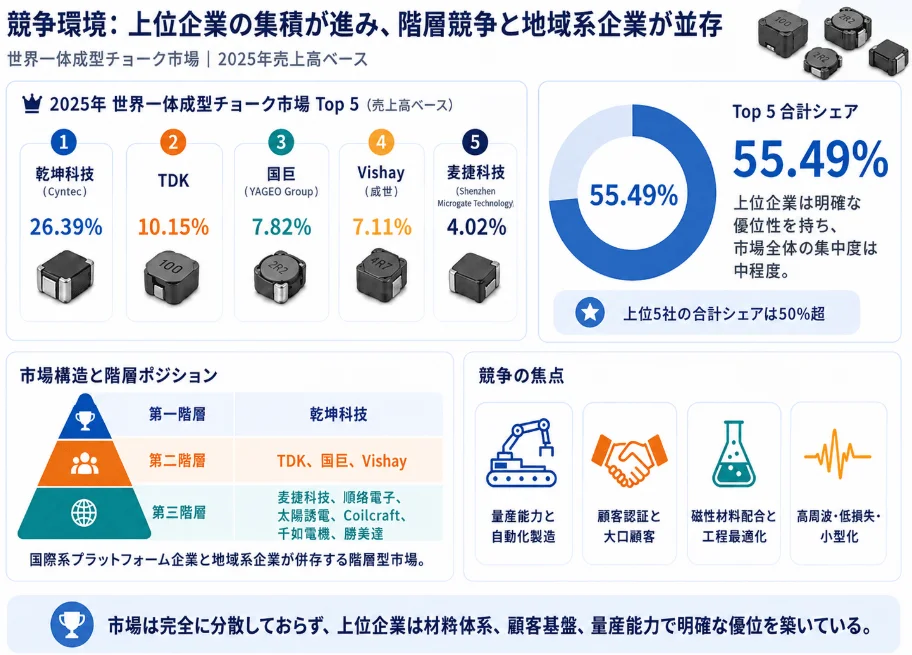
The top 5 manufacturers’ combined share in 2025 is reported as 55.49%, with Cyntec, TDK, YAGEO Group, Vishay, and Shenzhen Microgate Technology identified as major players. This market is not entirely fragmented, nor is it a complete oligopoly. Top-tier companies hold advantages in material technology, customer base, mass production capabilities, and certification compliance, while regional companies strengthen their presence through cost competitiveness, delivery times, and supply chain integration. The competition focuses on mass production automation, customer certification, magnetic material formulation, and high-frequency, low-loss, and miniaturization capabilities. For automotive applications, high-temperature environments, long-term reliability, and low resistance are particularly required. TDK Electronics, for example, offers 150°C-compatible high-current, low-DC resistance power inductors for automotive power circuits, indicating that automotive certification is a long-term barrier to entry.
Product Classification and Application Structure
The market demonstrates a clear shift in product structure. By type, small-sized products remain dominant, accounting for 67.6% in 2025 and projected to be 64.3% in 2032. This highlights the importance of miniaturization and high-density mounting in smartphones, laptops, wearables, and thin power modules. Conversely, the share of large-sized products is expected to rise from 32.4% to 35.7%, reflecting the expansion of high-current, high-reliability applications such as AI servers, EVs, industrial power supplies, and in-vehicle DC-DC systems.
By application, consumer electronics continue to be the largest segment, though their share is projected to slightly decrease from 72.7% to 69.5%. This does not signify a weakening of consumer electronics demand but rather indicates a higher growth rate in sectors like AI servers and automotive electronics. Future corporate competition will likely emphasize not only miniaturization but also design capabilities that simultaneously achieve high saturation current, low loss, low temperature rise, and thermal stability.
Regional Structure
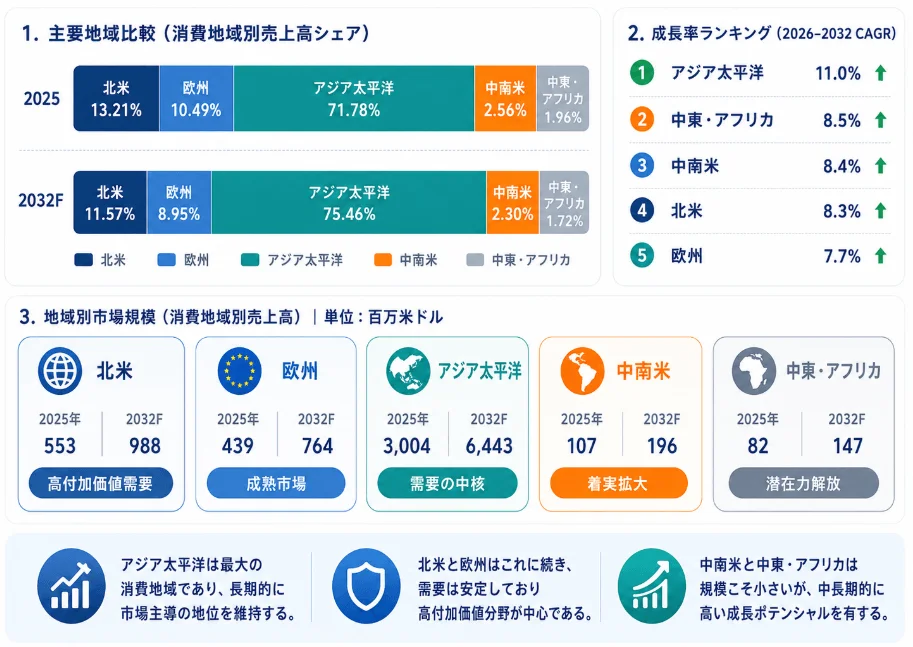
Asia is the central region for both production and consumption. Japan holds an advantage in material technology, while China and Taiwan are strong in the electronic industry chain. North America presents growth opportunities in AI infrastructure, and Europe in automotive electrification and industrial applications.
The Asia-Pacific region is indicated as the dominant consumption area, accounting for 71.78% in 2025 and projected to reach 75.46% in 2032F. This is attributed to the concentration of electronic device, server, automotive electronics, EMS, and semiconductor-related production in China, Taiwan, Japan, South Korea, and Southeast Asia. While North America and Europe hold smaller shares, they represent high-value-added demand in AI data centers, automotive electronics, industrial automation, and high-reliability power supplies. Asia-Pacific exhibits the highest growth rate at 11.0%, with the Middle East & Africa and Latin America also showing significant growth potential despite their smaller scale. According to WSTS, global semiconductor sales are projected to reach US$795.6 billion in 2025, driven by data center infrastructure and AI-related systems, forming a favorable external environment for high-performance passive components.
Industry Chain
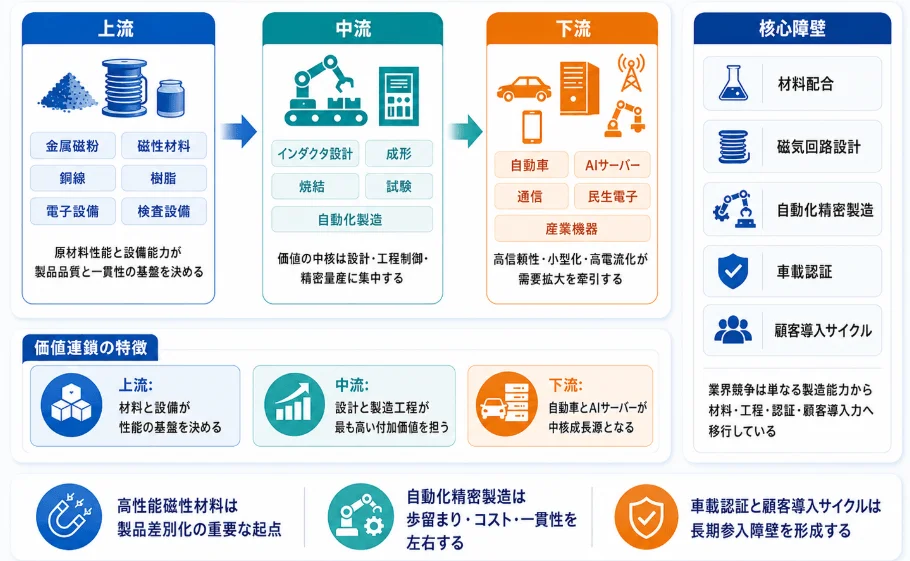
The upstream segment of the integrated molding choke industry consists of magnetic materials, metal magnetic powder, copper wire, resin, equipment, and testing devices. The midstream involves design, molding, sintering, testing, and mass production. Downstream applications include automotive, servers, communication, electronic devices, and industrial equipment.
This structure highlights where value creation is concentrated. The upstream materials and equipment determine the fundamental magnetic characteristics, loss, temperature characteristics, and consistency. The midstream, encompassing inductor design, molding, sintering, testing, and automated manufacturing, holds the highest added value. This is because magnetic circuit design, molding density, manufacturing variability, DCR, rated current, and temperature rise significantly influence final performance. Downstream, automotive and AI servers are expected to be the core growth drivers. In the long term, companies capable of integrating material formulation, magnetic circuit design, automated precision manufacturing, automotive certification, and customer adoption cycles are likely to gain a competitive edge in the integrated molding choke market.
Challenges and Future Outlook
Policy initiatives such as China’s