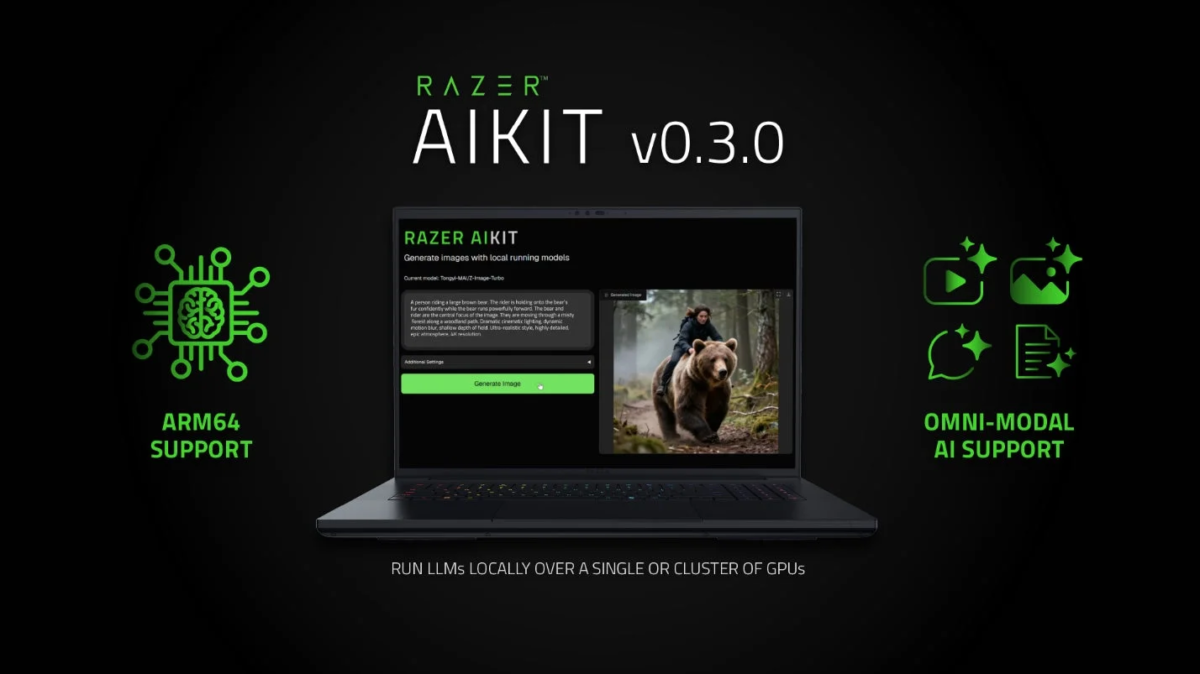
More Models. More Hardware. One Integrated Workflow.
Razer AI Kit enables the building, running, and deployment of advanced AI models on a developer’s own hardware, without reliance on cloud subscriptions. The toolkit automatically manages GPU detection, configuration, and performance tuning, leading to faster development cycles, predictable costs, and complete control over data and execution environments.
With this release, AI Kit has evolved into a complete omnimodal AI development toolkit capable of handling image generation, video, and audio models within a single, consistent workflow. These processes run locally on compatible systems, including Razer’s latest Blade series such as the Razer Blade 16 (2026) and Razer Blade 18 (2025). This makes advanced generative AI features, which previously required cloud infrastructure, available in local and edge environments.
Additionally, AI Kit supports image generation models like Tongyi-MAI/Z-Image-Turbo and FLUX.2-klein-base-4B. Developers can seamlessly prototype, test, and deploy using the same tools from experimentation to production.
New support for Arm64 architecture has also been added. This includes compatibility with systems featuring NVIDIA DGX Spark, NVIDIA Grace Hopper Superchip, and NVIDIA Grace Blackwell Superchip, allowing teams across x86 and Arm-based environments to deploy AI Kit consistently without altering their workflow or application infrastructure.
Technology Powering “Razer AVA Mini” Globally
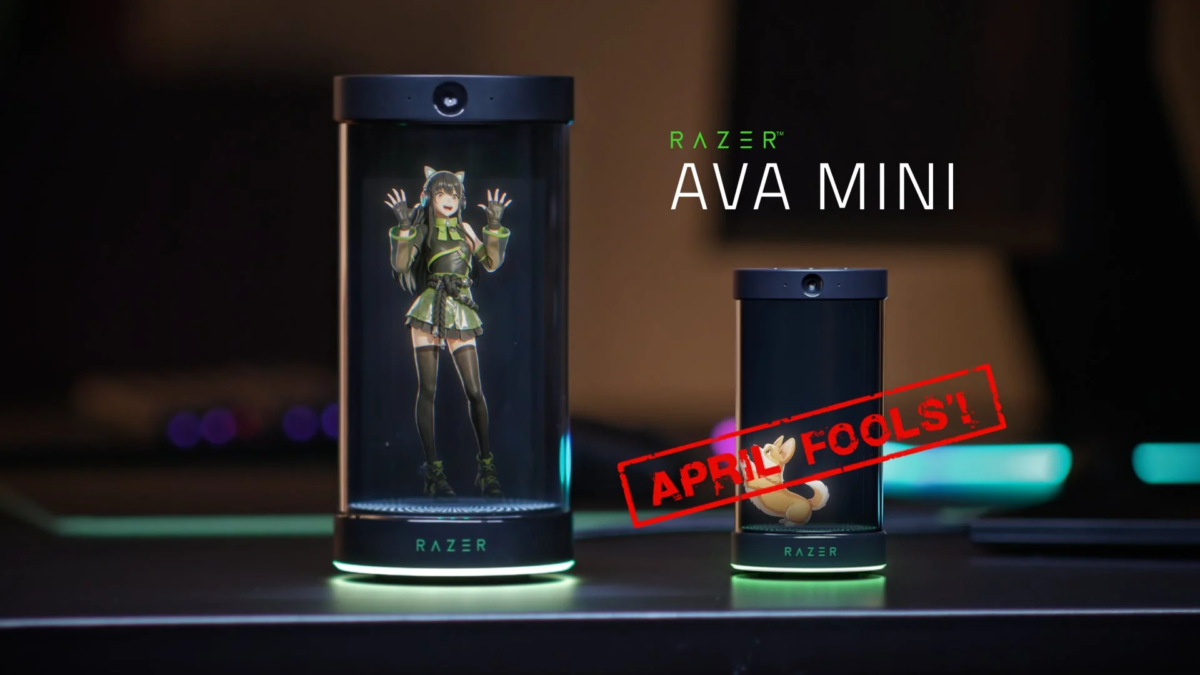
In March 2026, Razer announced “AVA Mini,” a 3D AI pet companion for its flagship AI desk companion, Razer AVA. This experience allowed users to upload photos of their real pets, generating a unique and personalized AVA Mini character in seconds. Razer actively promoted this initiative across various channels, generating high engagement leading up to the campaign’s launch in early April. This image generation experience was consistently powered by Razer AI Kit from development to production, demonstrating that the same toolkit used during development could support large-scale consumer deployments.
Typically, campaigns offering free, high-volume image generation are challenging to sustain cost-wise, with traditional cloud APIs incurring costs of approximately $0.03 to $0.15 USD per image. To address this, Razer partnered with Akash Network, a decentralized GPU marketplace, to deploy AI Kit via its managed inference service, “AkashML,” on a global pool of consumer RTX 4090 and RTX 5090 GPUs.
The campaign ran from March 31 to April 4, 2026, achieving the following results:
-
Over 11,000 images generated
-
An average end-to-end processing time of 3.24 seconds per image
-
A peak generation throughput of 30 images per minute
-
Zero manual intervention throughout the 5-day campaign
By deploying the AI Kit containers used during development directly onto Akash Network’s decentralized GPU network, inference costs were reduced to $0.01 USD per image, achieving up to 15 times greater cost efficiency compared to traditional cloud APIs.
Razer and Akash Network also released a joint whitepaper today, detailing the system architecture, unit economics, and engineering decisions of this deployment. The full paper is available at rzr.to/aikit-akash.
Availability on Akash Console
Razer AI Kit is now also available on Akash Console, Akash Network’s web-based management interface. This enables deployment and management of applications directly from a browser without the need for command-line operations, making it easier for developers and GPU operators to deploy AI Kit on a decentralized compute environment with an architecture similar to that used in the AVA Mini campaign.
Future Developments
The Razer AVA Mini campaign serves as an initial example of the practical potential of AI Kit beyond development use. Future updates are planned to include support for audio and video, enabling the creation of voice-driven interactions and video generation workflows within the same integrated AI Kit environment.
As a core component of Razer’s AI developer ecosystem, AI Kit is positioned as the software foundation for building, scaling, and deploying local-first AI.
AI Kit is currently available on GitHub, supported by continuous engineering team efforts from Razer and a growing global developer community. For downloads and more information, please visit razer.ai/AIKit.
About Razer
Razer™ is the world’s leading lifestyle brand for gamers. The triple-headed snake trademark of Razer is one of the most recognized logos in the global gaming and esports communities. With a fan base across every continent, Razer has designed and built the world’s largest gamer-focused ecosystem of hardware, software, and services. Razer’s award-winning hardware includes high-performance gaming peripherals and Blade gaming laptops. Razer’s software platform, with over 150 million users, includes Razer Chroma RGB and Razer Synapse for customization, lighting effects, and optimization. Razer also offers payment services for gamers, youth, millennials, and Gen Z with Razer Gold, one of the world’s largest game payment services, available in over 68,000 game titles, and Razer Silver, a rewards program linked to this payment service.
Razer is committed to realizing a sustainable future and strives to fulfill its social responsibilities through #GoGreenWithRazer activities, a 10-year roadmap to minimize environmental impact through various initiatives.
Founded in 2005, Razer has dual headquarters in Irvine, California, and Singapore, with regional headquarters in Hamburg and Shanghai, and 19 offices worldwide.
Razer Official Links
-
Razer Japan Official Website: https://www.razer.com/jp-jp/
-
Razer JP X (formerly Twitter) Account: https://www.x.com/razerjp