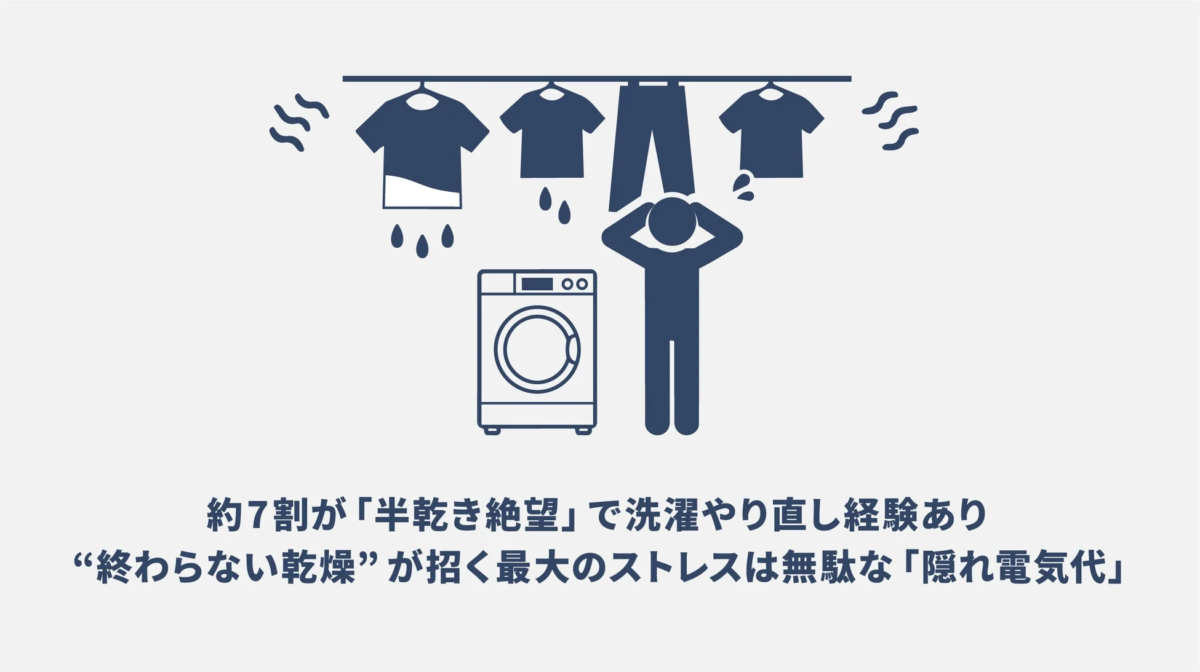
- Drum-Type Washer-Dryers: A Source of “Half-Dry Despair” and “Hidden Electricity Costs” for Many Users
- Key Survey Findings
- Survey Details
- Appliance Purchase Concerns Amidst Rising Prices
- Drying Performance Decline: A Common Experience for Users
- “Half-Dry Despair” Leads to Significant Time Loss
- “Hidden Electricity Costs” as the Primary Stressor
- Demand for Reduced Chores and Nighttime Laundry by Busy 30s
- Cleaning Efforts Meet “Blind Spots” in Internal Dust Accumulation
- Conclusion
- Comment from Consumer Life Advisor Yuki Wada
- Introducing New Drum-Type Washer-Dryer Models with a “Drying Longevity Unit”
- Industry-First Cyclone System “Drying Longevity Unit” for Extended Drying Performance
- Industry-First Automated Cleaning for Auto-Detergent Dispensing Path: “Triple Auto Dispenser” Now Even Easier and More Convenient
- Low Vibration Design Optimized for Japanese Homes and Reduced Washing Noise
- Related Information
Drum-Type Washer-Dryers: A Source of “Half-Dry Despair” and “Hidden Electricity Costs” for Many Users
Recent years have seen a rise in dual-income households and a growing demand for “time-saving performance” (Tai-Pa) in daily life, leading to the widespread adoption of drum-type washer-dryers as appliances that save time. However, prolonged use has brought new challenges to light. Panasonic Corporation conducted a survey targeting users of heat pump drum-type washer-dryers to understand their washing habits and concerns. The survey revealed issues such as time loss due to declining drying performance and anxiety over unnecessary electricity costs, highlighting current challenges in laundry drying. The detailed survey results are presented, along with comments from Consumer Life Advisor Yuki Wada on “Maintenance Performance” (Iji-Pa), focusing on how to wisely and sustainably use daily appliances.

Key Survey Findings
-
In an era of rising prices, approximately 90% of individuals are concerned about regretting or making a mistake when purchasing home appliances. The most common appliance for which people reported regret or a desire to avoid failure was the “washing machine.”
-
Approximately 60% of heat pump drum-type washer-dryer users reported experiencing a “decline in drying performance.” More than half of these users experienced this within less than three years of purchase.
-
About 70% of users have experienced “half-dry despair,” leading to re-drying. Over half of these instances resulted in a time loss of one hour or more.
-
The biggest stress caused by endless drying is “hidden electricity costs.” Over 80% expressed anxiety or a sense of wastefulness regarding unnecessary electricity consumption due to extended drying.
-
Approximately 90% expressed a desire to reduce the burden of household chores. Notably, 40% of busy individuals in their 30s perform laundry at night.
-
While over half of users diligently clean filters and drying paths themselves, approximately one in three were unaware that “dust accumulation inside the heat exchanger” is a primary cause of drying performance degradation.
Survey Details
-
Region: Nationwide
-
Target: 800 men and women aged 20-70 using drum-type washer-dryers (heat pump type)
-
Period: June 17 (Wednesday) – June 19 (Friday), 2026
-
Commissioned by: Rakuten Insight, Inc.
Appliance Purchase Concerns Amidst Rising Prices
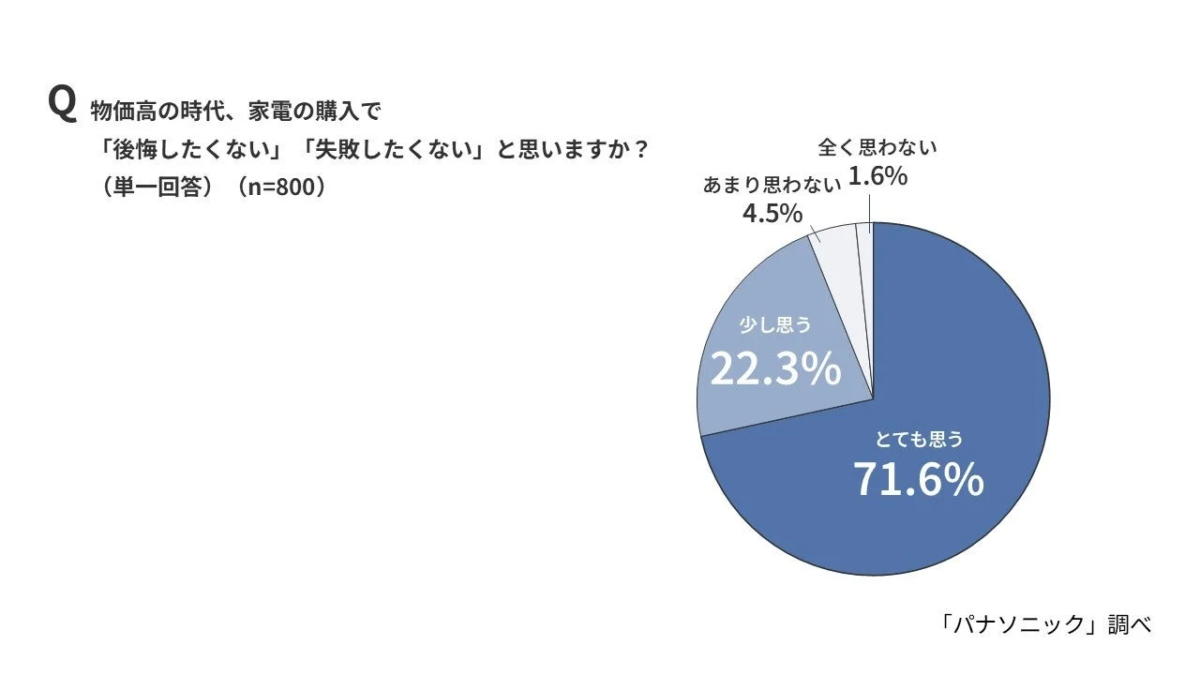
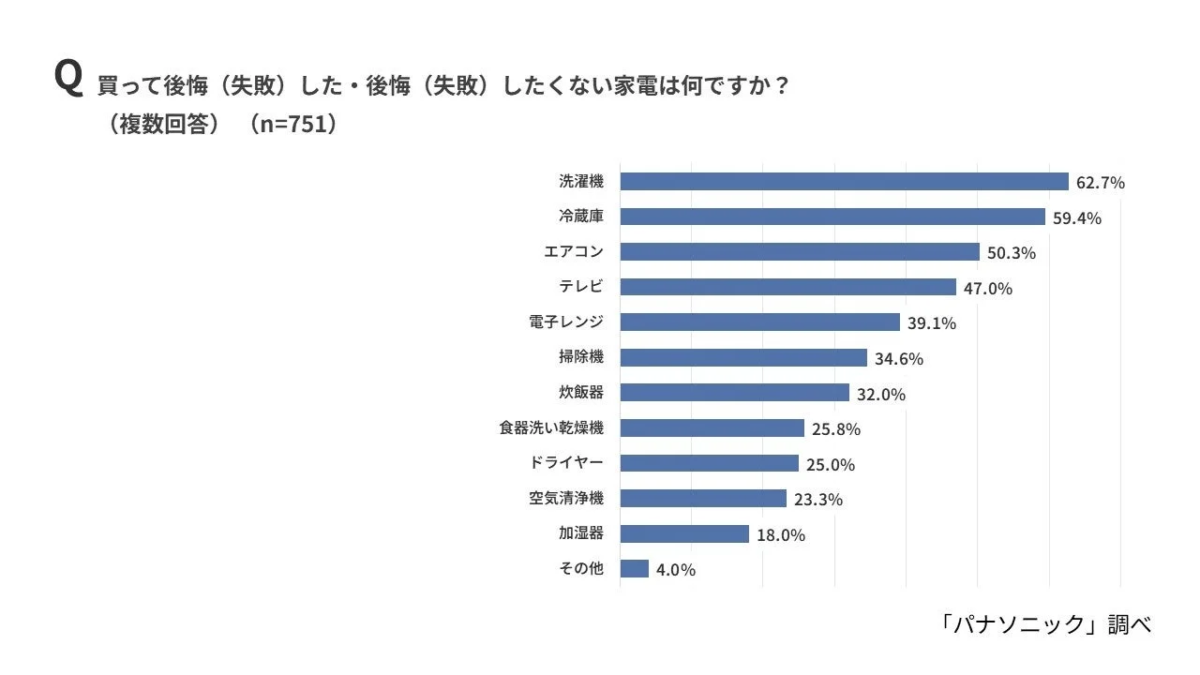
In the current climate of rising prices, 93.9% of respondents (71.6% “strongly agree,” 22.3% “somewhat agree”) indicated a strong desire to avoid regret or failure when purchasing home appliances. When asked which appliances they regretted purchasing or wished to avoid making a mistake with, “washing machines” topped the list at 62.7%, followed by “refrigerators” (59.4%) and “air conditioners” (50.3%). This suggests that consumers are particularly critical when choosing washing machines, which are essential daily items and significant investments.
Drying Performance Decline: A Common Experience for Users
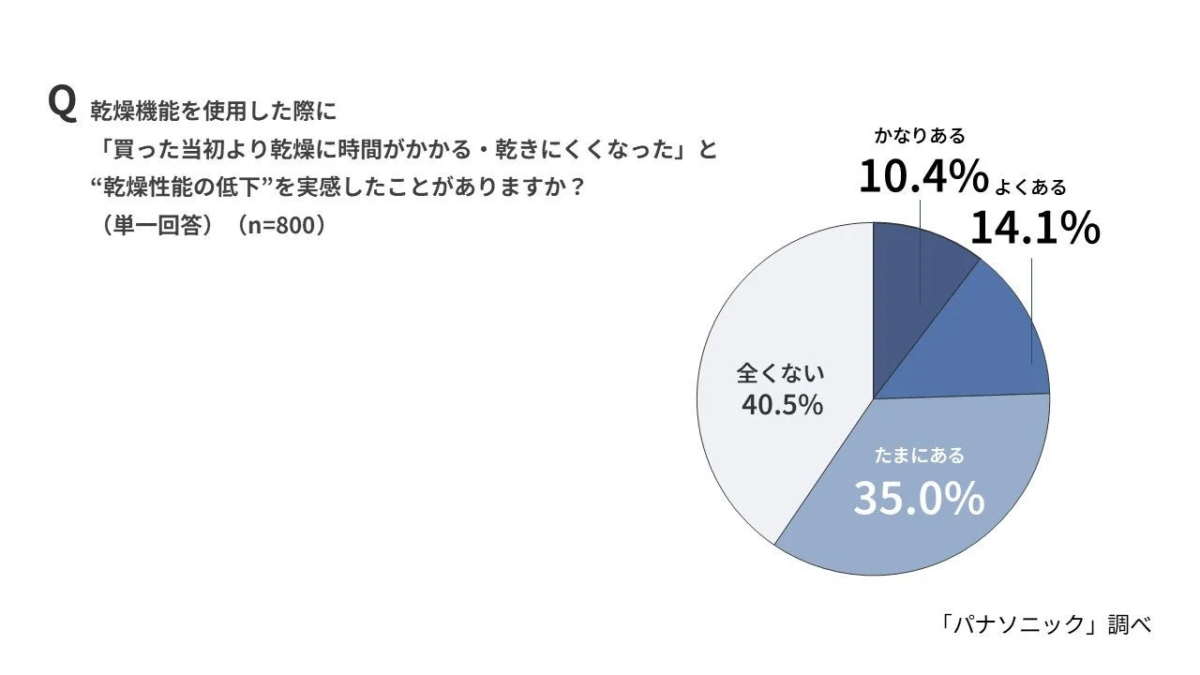
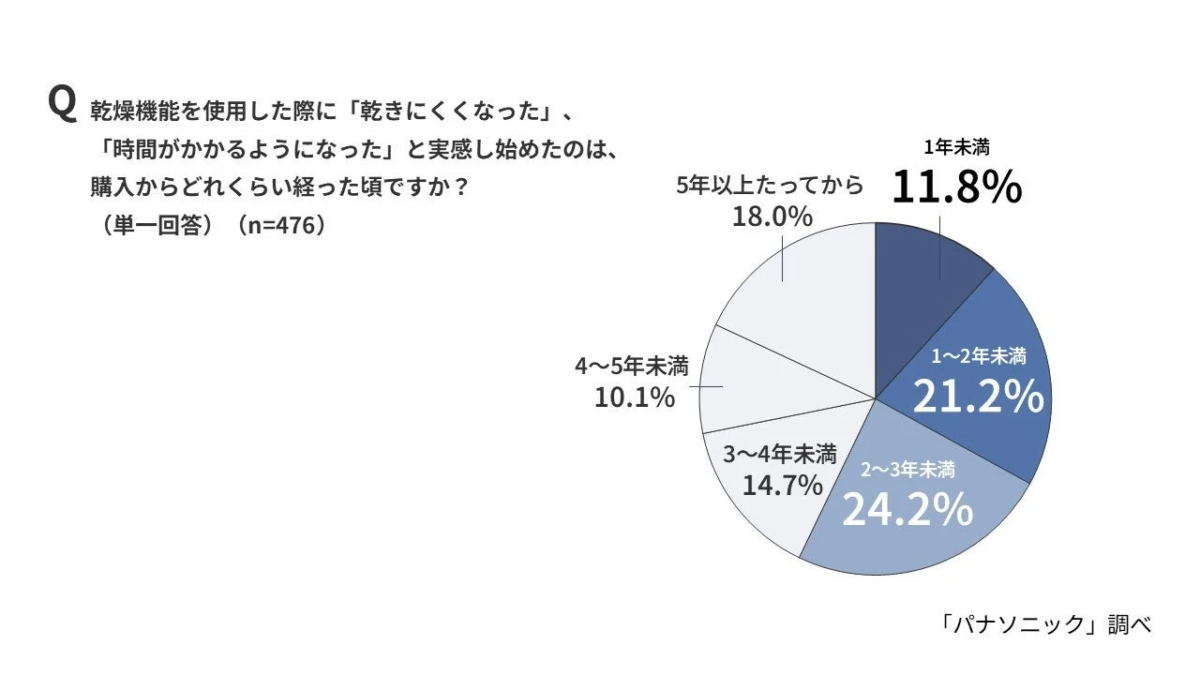
Approximately 60% (59.5%) of users reported experiencing a decline in drying performance, noting that drying takes longer or clothes are harder to dry compared to when the appliance was new. Among those who experienced this, 57.2% noticed the decline within less than three years of purchase, indicating that more than half experienced issues relatively early.
“Half-Dry Despair” Leads to Significant Time Loss
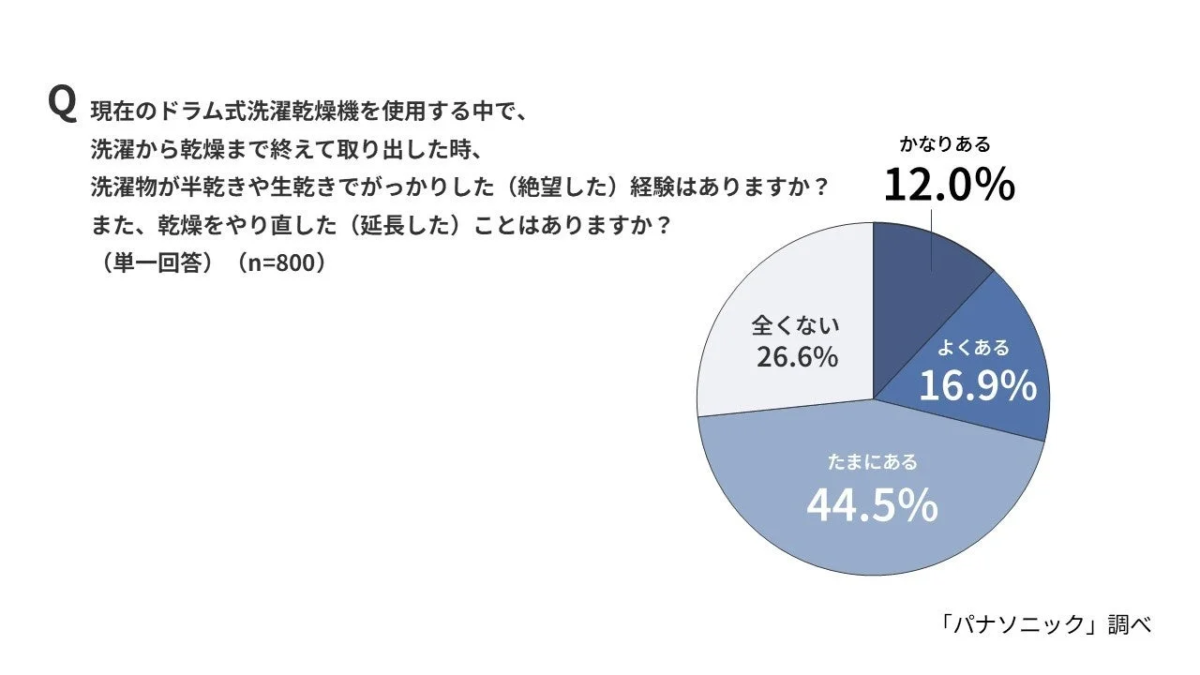
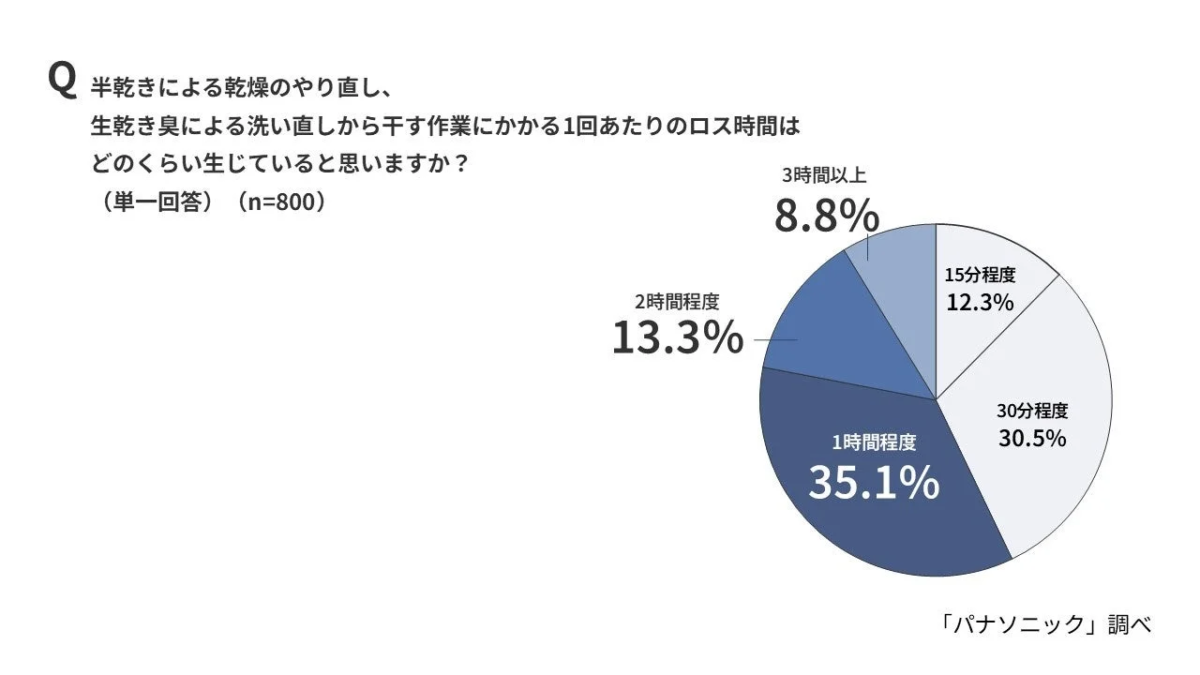
When asked if they had experienced disappointment (despair) or had to re-dry (extend drying) laundry due to clothes being damp or half-dry after a full wash and dry cycle, 73.4% of respondents answered “quite often,” “often,” or “sometimes.” Furthermore, regarding the “time loss per incident” caused by half-dry laundry or re-drying, “about 1 hour” was the most common response (35.1%). Combining this with those who reported “about 2 hours” (13.3%) and “3 hours or more” (8.8%), over half (57.2%) experienced a time loss of more than one hour. Despite being purchased as a “time-saving appliance,” drum-type washer-dryers appear to cause time loss in daily life due to inherent drying performance limits or degradation over time.
“Hidden Electricity Costs” as the Primary Stressor
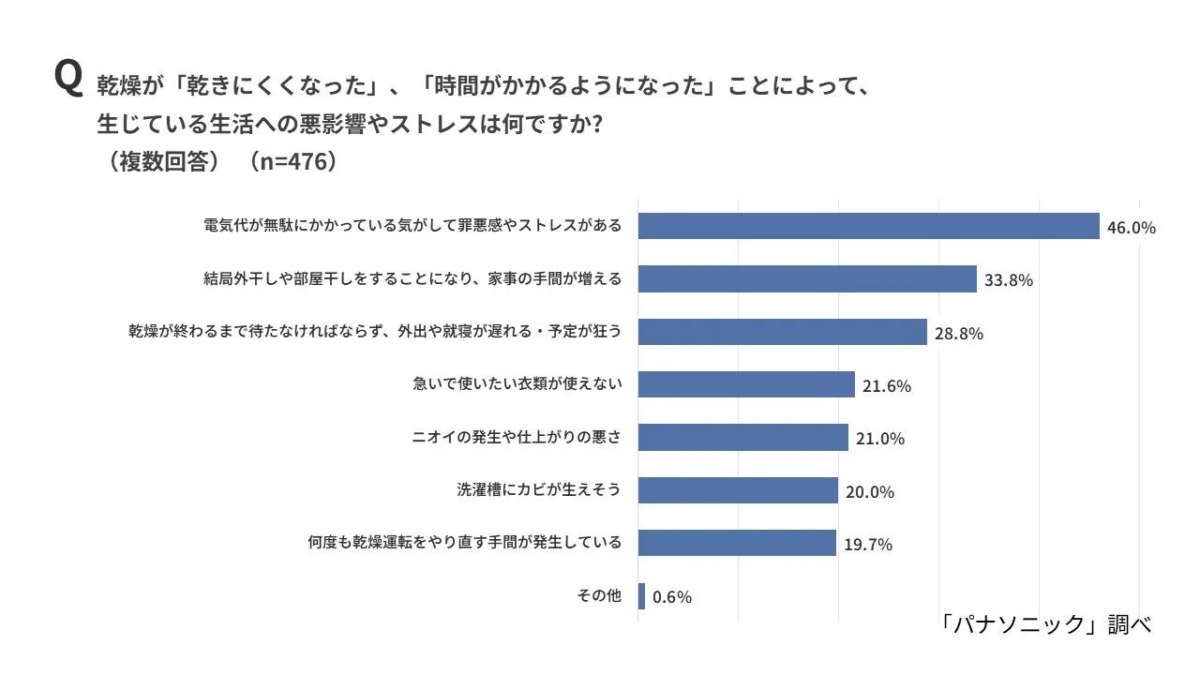
When asked about the negative impacts or stress caused by declining drying performance (taking longer to dry or not drying completely), the most frequent response was “feeling guilt or stress due to seemingly wasted electricity costs” (46.0%). Other common responses included “ending up line-drying or indoor-drying, increasing household chores” (33.8%) and “having to wait for drying to finish, delaying outings or bedtime, or disrupting plans” (28.8%). This indicates that financial pressure, along with time-related disruptions, are significant sources of stress.
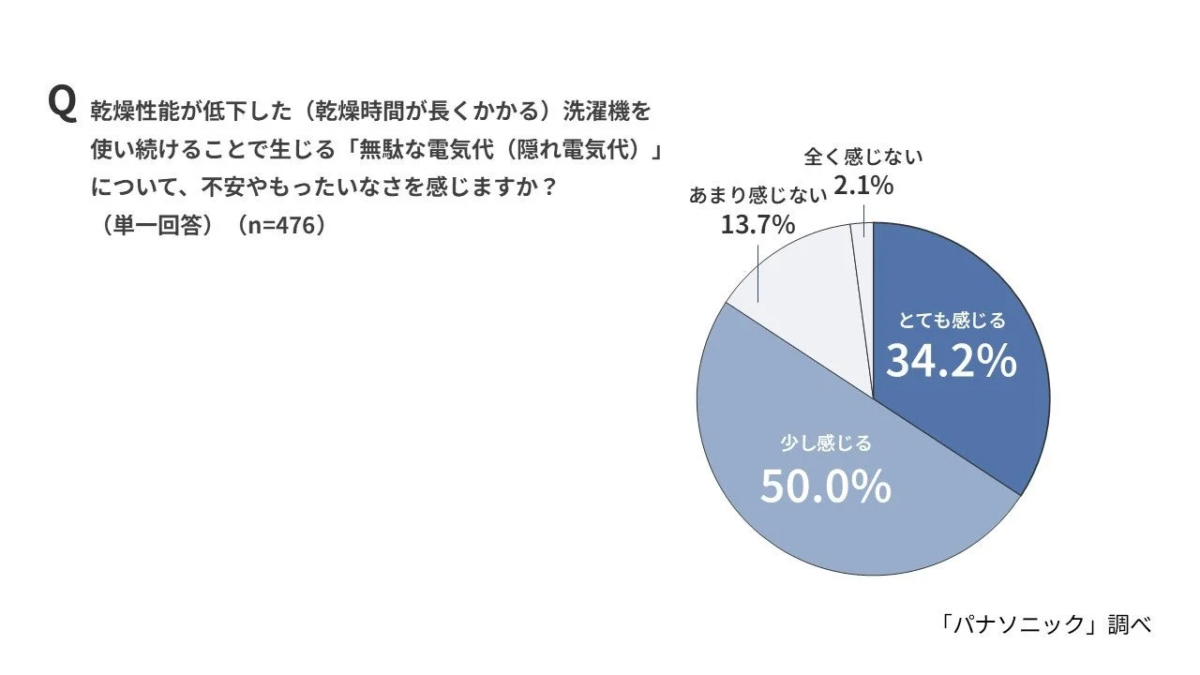
Furthermore, 84.2% of respondents (34.2% “strongly feel,” 50.0% “somewhat feel”) expressed anxiety or a sense of wastefulness regarding the “unnecessary electricity costs (hidden electricity costs)” incurred by continuing to use a washing machine with reduced drying performance. User comments also reflected this, with one 30-year-old male stating, “Sometimes drying is poor, and electricity bills become unexpectedly high.” Against the backdrop of recent price hikes and soaring electricity costs, the dilemma of drying performance degradation in drum-type washer-dryers creating unexpected financial burdens and psychological stress is evident.
Demand for Reduced Chores and Nighttime Laundry by Busy 30s
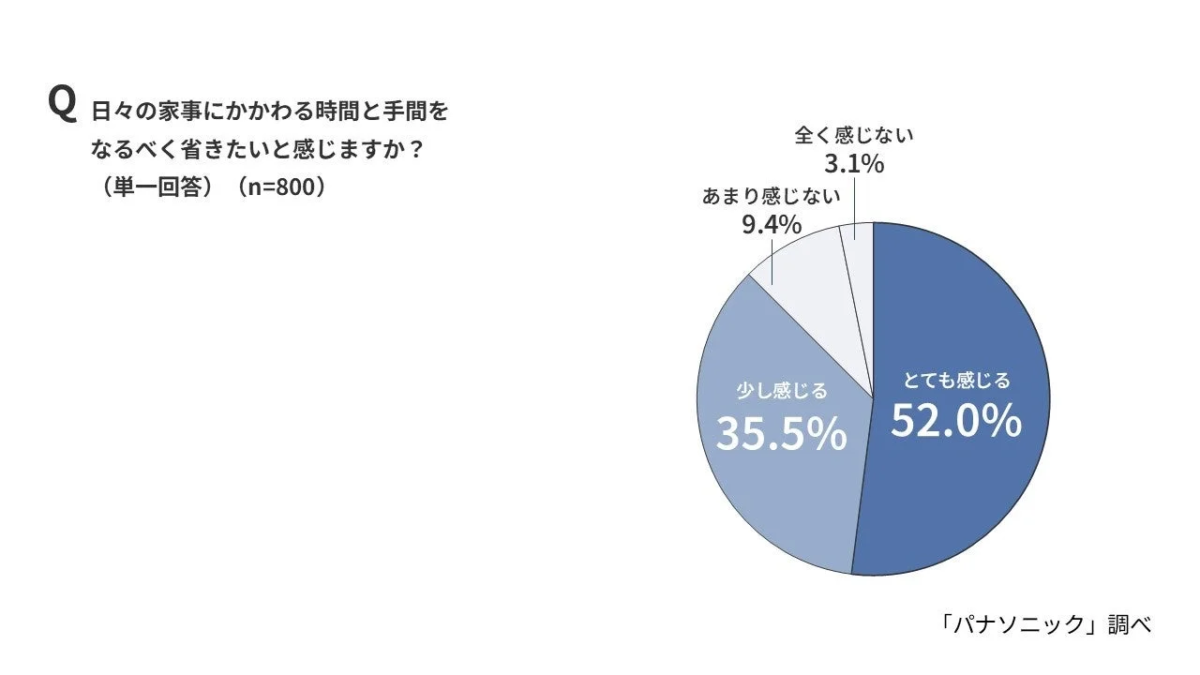
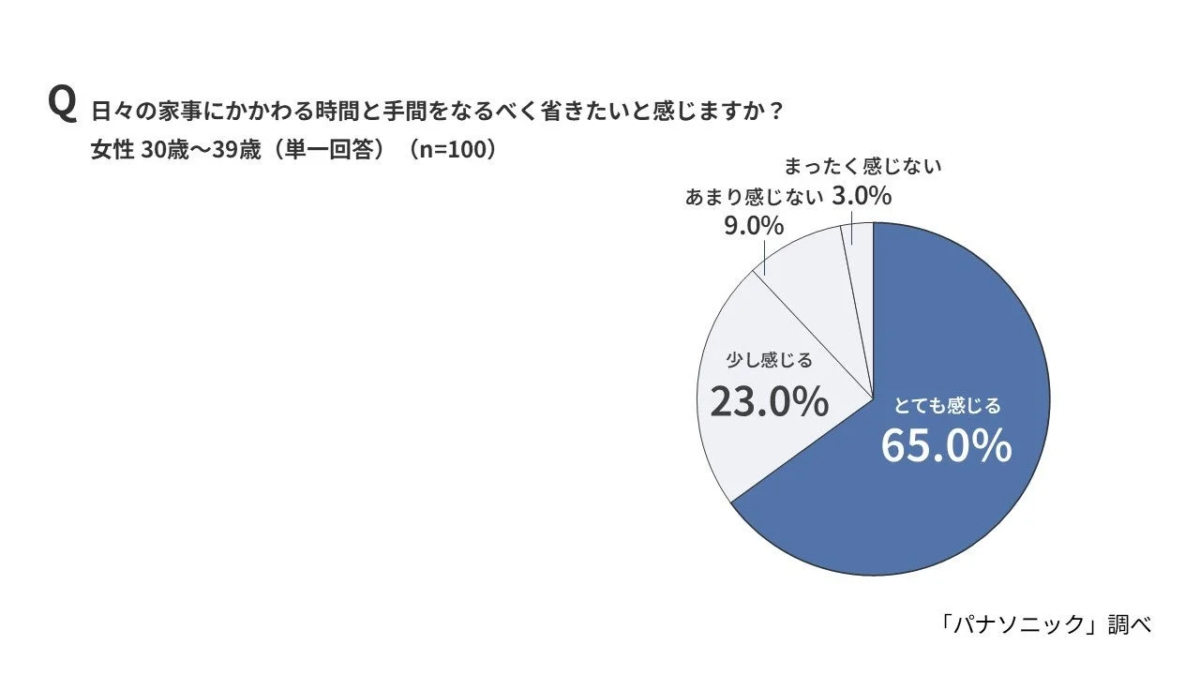
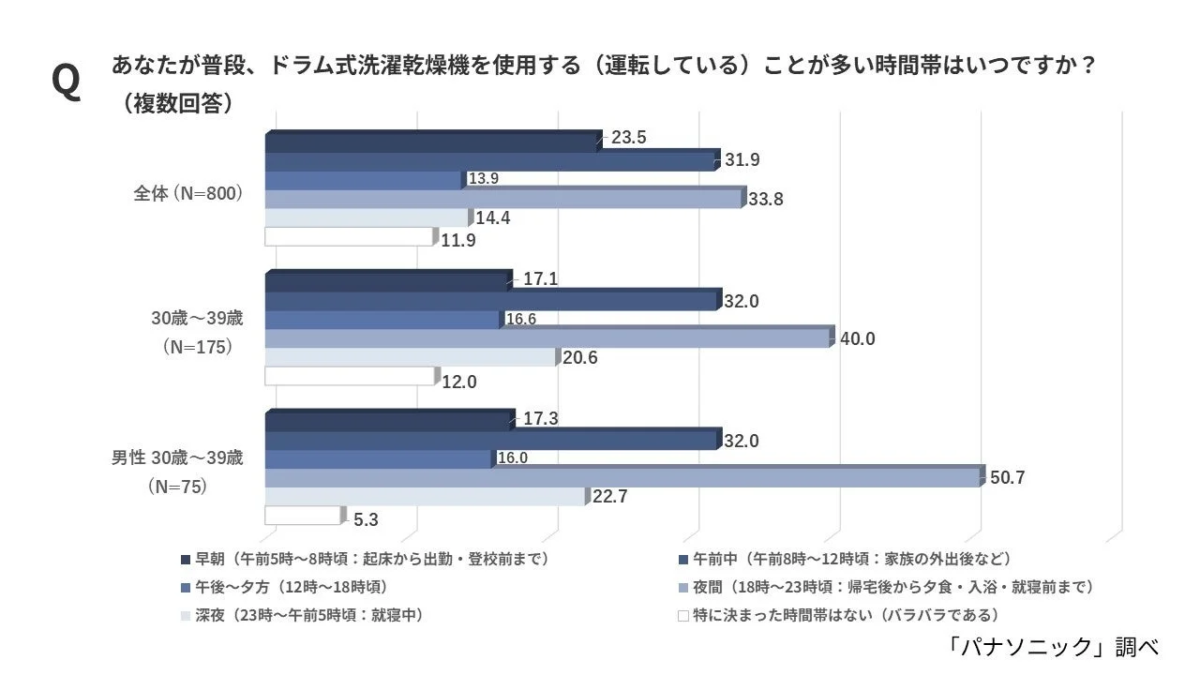
Approximately 90% of respondents (52.0% “strongly feel,” 35.5% “somewhat feel”) expressed a desire to reduce the time and effort involved in daily household chores. This sentiment was particularly strong among women in their 30s, a busy generation juggling work and childcare, with 65.0% responding “strongly feel.” Regarding the most common time for using drum-type washer-dryers, 40.0% of individuals in their 30s reported using it “at night (around 6 PM – 11 PM: after returning home until before dinner, bathing, and bedtime),” which is higher than the overall average of 33.8%. This trend was even more pronounced among men in their 30s, with over half (50.7%) doing laundry at night, highlighting the busy modern lifestyle of single individuals or dual-income households who must complete chores in limited time after work.
Cleaning Efforts Meet “Blind Spots” in Internal Dust Accumulation
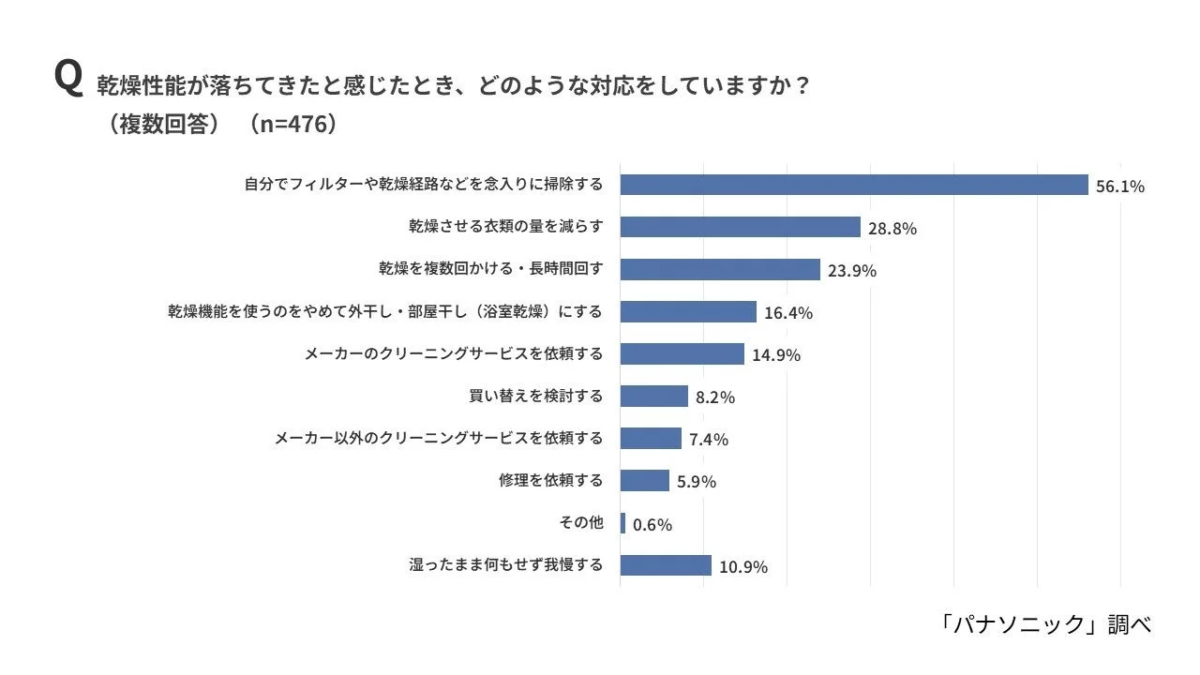
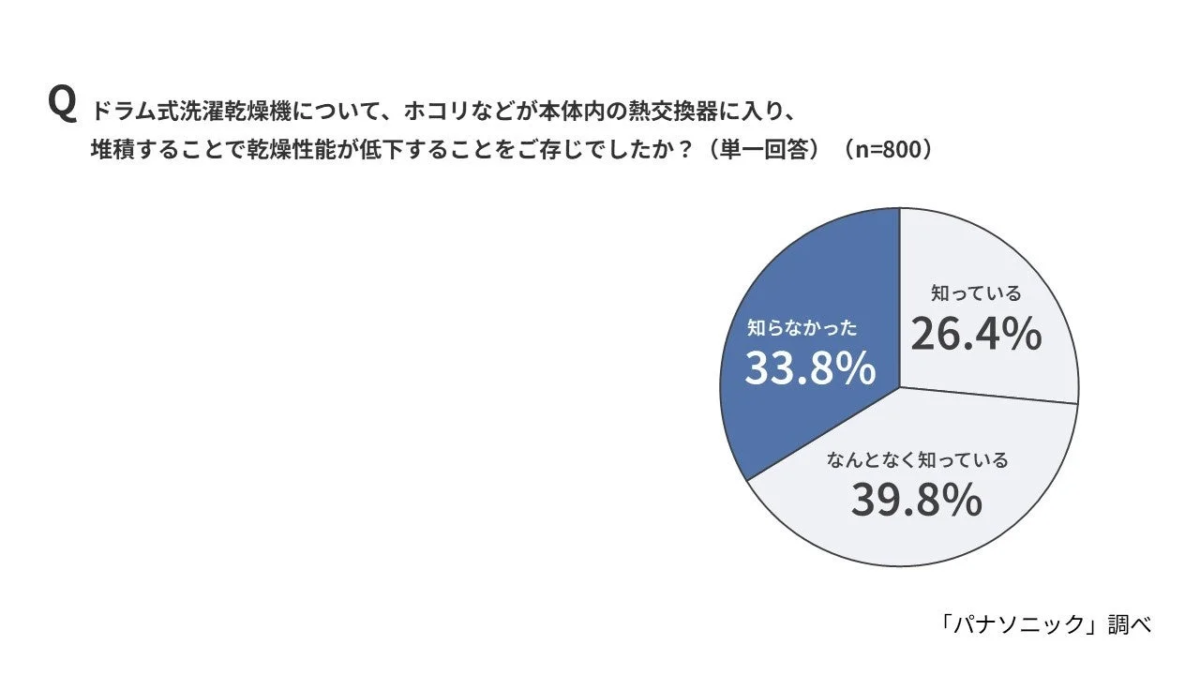
In drum-type washer-dryers, dust that is not caught by the filter can accumulate in the heat exchanger, a key component of heat pump drying, leading to longer drying times and uneven drying. When asked about actions taken when drying performance declines, many respondents (56.1%) reported “meticulously cleaning filters and drying paths themselves.” However, approximately one in three (33.8%) were unaware that “dust accumulation in the heat exchanger inside the main unit is a primary cause of performance degradation.”
Furthermore, about 60% (60.8%) of respondents were unaware of manufacturer-provided “heat exchanger cleaning services,” indicating a “limit to self-maintenance and a blind spot” where effective means of restoring performance are not fully utilized. Users expressed frustration about “dust deep inside”: a 40-year-old male commented, “Even if I regularly remove dust from the filter, I can’t remove dust from the heat exchanger area behind it, and there’s a limit to what consumers can do for maintenance.” A 30-year-old female added, “I can remove dust from the filter, but it’s annoying when dust gets stuck deeper than the filter, and I can’t remove that clump of dust.” Moving forward, when choosing a drum-type washer-dryer, not just high initial performance but “Maintenance Performance” (Iji-Pa) – the ability to maintain initial performance over long-term use – is likely key to a satisfying purchase.
Conclusion
The survey revealed that despite purchasing drum-type washer-dryers as “time-saving appliances,” approximately 60% of users experienced a “decline in drying performance” due to long-term use. The time loss caused by endless drying and the associated anxiety over “hidden electricity costs” are significant stressors in modern society, where rising prices and the demand for reduced household chores are prevalent. Moreover, awareness of the root cause of performance degradation – “dust accumulation in the heat exchanger inside the main unit” – remains low, even with diligent filter cleaning. This highlights a “limit to self-maintenance and a blind spot” that is difficult for users to resolve on their own.
Comment from Consumer Life Advisor Yuki Wada

“Washer-dryers are a prime example of time-saving appliances, often referred to as the ‘three sacred treasures’ of the Reiwa era. However, with prolonged use, a decline in drying performance can become a major daily stressor. Even with daily filter cleaning, there are limits to self-maintenance, and internal dust accumulation can degrade drying performance. This can lead to re-drying or requiring outdoor drying, ultimately increasing the burden of household chores. Therefore, when purchasing, it is crucial to consider not just the price but also whether the ‘drying performance will last.’ Additionally, regularly utilizing professional cleaning services, in addition to daily filter cleaning, is key to maintaining initial comfort for a longer period. Choosing products with sustained drying performance and proper maintenance offers significant benefits in terms of ‘cost performance’ (Cos-Pa) by curbing unexpected electricity costs from re-drying, and ‘time performance’ (Tai-Pa) by saving wasted time and creating reliable time, leading to long-term satisfaction. Since washer-dryers are expensive and indispensable home appliances, it is important not to give up and think ‘it’s inevitable that drying performance will decline with use.’ Instead, by incorporating professional maintenance and choosing products that fit one’s lifestyle, one can not only ‘use them for a long time’ but ‘use them comfortably for a long time.’ This mindset not only improves cost and time performance, leading to savings and enhanced quality of life, but also directly reduces daily household stress and fosters peace of mind.”
Introducing New Drum-Type Washer-Dryer Models with a “Drying Longevity Unit”
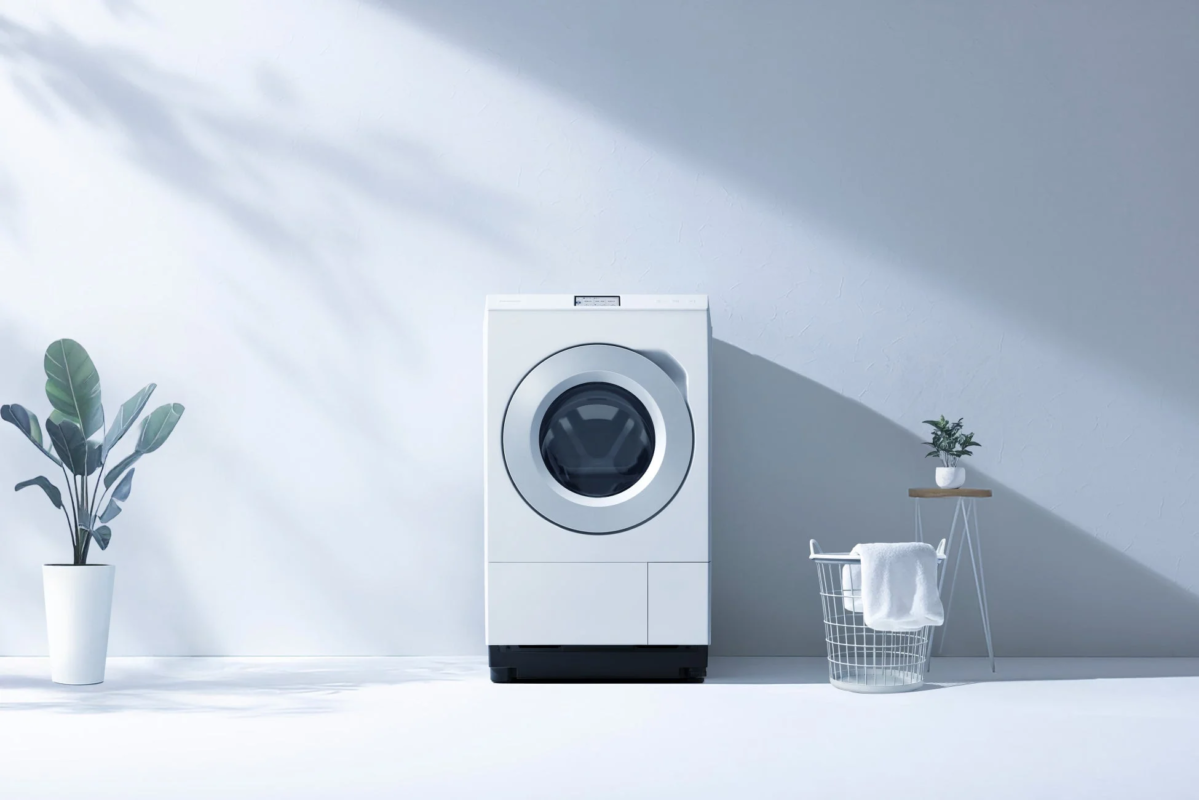
Panasonic introduces new drum-type washer-dryer models featuring an industry-first “Drying Longevity Unit” to ensure excellent drying performance lasts longer and maintenance is easier. The new NA-LX129FL and three other models will be released in early October.
Industry-First Cyclone System “Drying Longevity Unit” for Extended Drying Performance
One of the main reasons for declining drying performance and longer drying times is the clogging of the heat exchanger. If dust and hair not caught by the filter enter the heat exchanger, hair can cause dust to accumulate, preventing the drying performance from being fully realized. The newly developed “Drying Longevity Unit” employs a cyclone system that captures dust and hair by swirling the air, collecting them into clumps. This system catches over 99.9% of hair that traditional mesh filters miss, preventing it from entering the heat exchanger. By reducing heat exchanger clogging, the initial drying performance can be maintained for a longer period. The collected dust and hair in the box can be easily removed with the push of a button.
New models equipped with the “Drying Longevity Unit” will also extend the application period for the heat pump unit cleaning service to five years after purchase.
For more details on the “Drying Longevity Unit,” please visit:
https://panasonic.jp/wash/feature/LX/heatpump.html
Industry-First Automated Cleaning for Auto-Detergent Dispensing Path: “Triple Auto Dispenser” Now Even Easier and More Convenient
For more details on the “Triple Auto Dispenser,” please visit:
https://panasonic.jp/wash/feature/LX/auto.html
Low Vibration Design Optimized for Japanese Homes and Reduced Washing Noise
For more details on the low vibration design and reduced noise, please visit:
https://panasonic.jp/wash/feature/LX/compact-big.html
Related Information
-
Product Details and Specifications:
https://panasonic.jp/wash/products/NA-LX129FL.html -
Details on the heat pump unit cleaning service:
https://panasonic.jp/wash/service/heatpump-cleaning.html -
General information about Panasonic washing machines:
https://panasonic.jp/wash/