Power Track Socket Market Overview
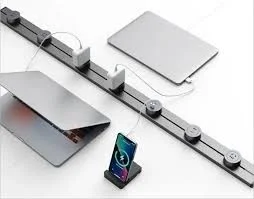
The power track socket market has experienced rapid growth in recent years, driven by the increasing adoption of smart home technologies and advanced spatial design. Power track sockets, which are variable power supply systems featuring power modules that can move freely along conductive aluminum alloy rails, offer a solution to the challenges posed by traditional fixed outlets, such as inflexible placement, insufficient ports, and wiring constraints. In 2024, global production was estimated at approximately 82,000 units, with an average market price of about US$35 per unit. Key growth drivers include smart power distribution, modular power, IoT home equipment, USB-C integrated power supply, and space-saving designs, with accelerating adoption in luxury homes, offices, and commercial facilities.
Market Size and Growth Forecast
According to the latest report by QY Research, titled “Power Track Socket – Global Market Share and Ranking, Overall Sales and Demand Forecast, 2026-2032,” the global power track socket market was estimated at US$2978 million in 2025 and is projected to reach US$3074 million in 2026. The market is then expected to expand at a Compound Annual Growth Rate (CAGR) of 3.6% from 2026 to 2032, reaching US$3801 million by 2032.
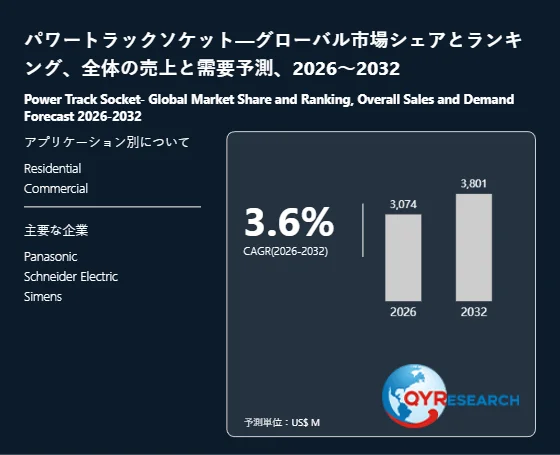
The chart and data above are cited from QY Research’s latest report, “Power Track Socket – Global Market Share and Ranking, Overall Sales and Demand Forecast, 2026-2032.”
Product Structure and Technological Evolution
Power track sockets consist of conductive aluminum rails, movable adapters, internal insulation structures, and overcurrent protection mechanisms. Users can move and add power modules to any position on the rail and combine them with USB-C, wireless charging, and fast-charging ports as needed. The primary distinction from conventional outlets lies in their ability to adapt flexibly to changing spaces. Demand for movable power systems is particularly surging in open kitchens, co-working spaces, luxury hotels, and showrooms, where layout changes are frequent. In the first half of 2025, Chinese manufacturers, among others, introduced next-generation power track sockets featuring energy consumption visualization and smartphone connectivity. High-end models have also begun implementing AI-linked standby power control and overload warning functions.
Key Market Drivers
The expansion of the power track socket market is underpinned by the growing demand for smart and highly designed residential spaces. The proliferation of IoT appliances, in particular, necessitates a more flexible power supply infrastructure than ever before. Fixed outlets struggle to accommodate environments where numerous electronic devices, such as USB-C compatible laptops, tablets, smart speakers, and small appliances, are used simultaneously. The rise of remote work also contributes to market growth. For home office applications, adaptability to desk rearrangements and device additions is crucial, leading to increased adoption of power track sockets. In Europe and North America, “concealed wiring space design” is a key factor in enhancing residential value, driving demand for products that combine interior aesthetics with functionality. In emerging markets, urbanization fuels growth, with an increase in high-rise residential and commercial building construction in Southeast Asia, Latin America, and the Middle East, accelerating market penetration by cost-competitive Chinese brands.
Technical Challenges and Competitive Risks
Despite the market’s growth, several technical challenges exist. The primary concern is safety. While the movable power supply structure offers convenience, it requires stringent measures against contact failures, arc discharges, foreign object intrusion, and overheating risks. Especially for high-output USB-C PD power supply compatible models, thermal management and durability design are critical. Furthermore, compliance with national electrical safety standards poses a barrier to entry, as certification costs (e.g., European CE, North American UL, Chinese CCC) can be substantial for small and medium-sized manufacturers. The increase in low-priced imitation products also contributes to a widening quality gap in the market. In 2025, some manufacturers began adopting recycled aluminum and plastic, accelerating the shift towards environmentally friendly products. However, achieving circular design necessitates component interchangeability and extended lifespan technologies, making differentiation difficult through simple price competition alone.
Application-Specific Demand Trends and Future Outlook
While the residential market remains the largest demand sector, future growth in commercial spaces is notable. Offices, hotels, restaurants, and retail stores are increasingly adopting these systems for their layout flexibility and aesthetic enhancement. Luxury commercial facilities, in particular, are seeing an increase in embedded floor and furniture-integrated power track sockets. Demand for flexible power configurations is also rising in educational and medical facilities, expanding the need for multi-functional modular products. Recent developments include next-generation models with EV charging assistance and integration with energy management systems. Future competition is expected to shift towards “design,” “safety,” “smart integration,” “environmental compatibility,” and “modular expandability.” Power track sockets are positioned not merely as power distribution components but as crucial elements of smart space infrastructure, anticipating sustained growth in the medium to long term.
This article is based on the QY Research report “Power Track Socket – Global Market Share and Ranking, Overall Sales and Demand Forecast, 2026-2032,” providing an overview of market trends and competitive analysis.
For more details and a free sample of the report, please visit:
Contact Information
QY Research Co., Ltd.
URL: https://www.qyresearch.co.jp
Address in Japan: UCF 5F, Ginza Wall Building, 6-13-16 Ginza, Chuo-ku, Tokyo 104-0061
TEL: 050-5893-6232 (Japan); 0081-5058936232 (Global)
Marketing Department: mailto:japan@qyresearch.com
Company Profile
QYResearch (QY Research) is a market research and consulting firm established in Tokyo in 2017. It offers a wide range of services, including market research reports, custom research, and IPO-related consulting, targeting global markets. The company comprehensively analyzes market trends, growth potential, and competitive structures across various industries. To date, QYResearch has provided industrial information services to over 65,000 companies in more than 160 countries and regions, leveraging its extensive research experience and global network. It has earned high trust and recognition from many Japanese companies, particularly in areas such as competitive analysis, market size forecasting, industry structure analysis, and customized research.