
- Earthquake-Sensing Breakers: The Ultimate Lifesaver Against Post-Quake Fires
- 1. Most Fatalities are Victims of “Fires”
- 2. Government Action: From 20% Installation Rate to “Widespread Installation”
- 3. “I Rent,” “Too Expensive” Are Misconceptions! How to Choose for Your Home
- 4. Seriousness of National and Local Governments – “Virtually Zero Cost” with Subsidies
- Conclusion: To Avoid Becoming a Perpetrator in an Emergency
Earthquake-Sensing Breakers: The Ultimate Lifesaver Against Post-Quake Fires
On May 29, Kyodo News reported on the government’s revised “Emergency Response Promotion Basic Plan,” which sets a strong national goal to reduce the maximum projected casualties from a Tokyo Inland Earthquake (approximately 18,000 people) by more than half within the next decade. While preparing for major earthquakes often brings to mind storing water and food or securing furniture, the government has identified the installation of “earthquake-sensing breakers” as the “ultimate trump card” to accelerate the reduction of fatalities.
Why is the government so urgently promoting the widespread adoption of earthquake-sensing breakers now? This article explains the reality of “communal power-on fires” that you should know to protect your home and life, along with specific countermeasures.
-
Reference: Ministry of Economy, Trade and Industry https://www.meti.go.jp/policy/safety_security/industrial_safety/oshirase/2015/10/270105-1.html
-
Reference: Fire and Disaster Management Agency, Ministry of Internal Affairs and Communications “What are earthquake-sensing breakers” https://www.fdma.go.jp/relocation/html/life/yobou_contents/materials/pdf/29_zisin.pdf
1. Most Fatalities are Victims of “Fires”
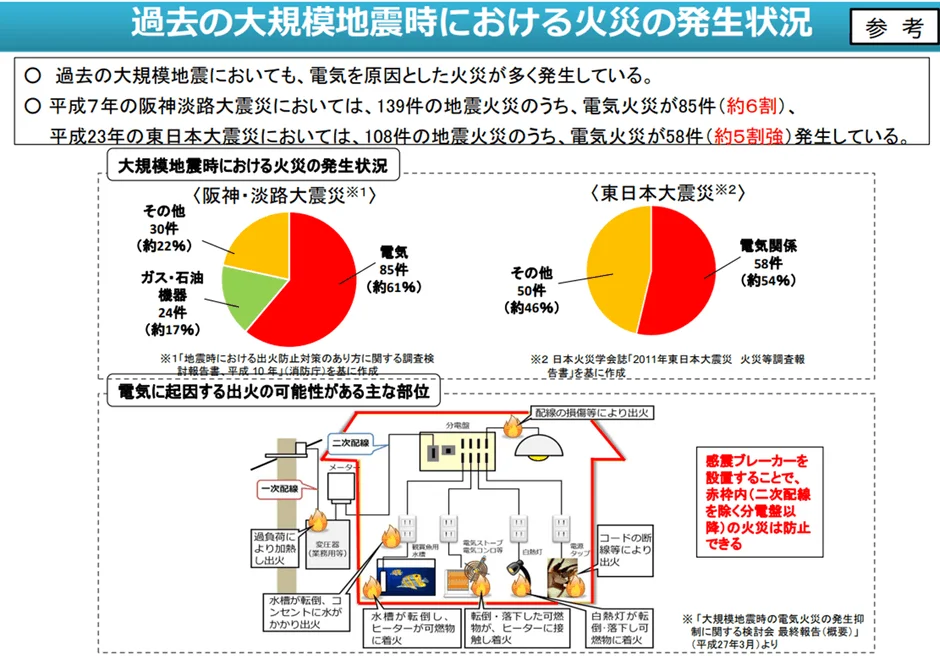
The primary reason the government is rushing to popularize earthquake-sensing breakers is the assumption that most casualties in a Tokyo Inland Earthquake will not be from building collapse itself, but from “building fires.” In urban areas with dense wooden housing, “communal power-on fires” are a particular concern.
The terrifying mechanism of communal power-on fires:
- A major earthquake occurs, and the entire area experiences a large-scale power outage.
- Residents rush to evacuation shelters for safety.
- Several hours to days later, power is restored to the area through power company restoration work.
- Electricity flows to fallen heaters or cords severed by collapsed furniture, causing a fire in an unoccupied house.
In the Great Hanshin-Awaji Earthquake and the Great East Japan Earthquake, which caused immense damage in the past, over half of the fire causes were “electricity-related.” During major disasters, roads are cut off, and fire trucks cannot arrive immediately. Small fires starting in unoccupied homes can quickly lead to a catastrophe that engulfs entire towns.
2. Government Action: From 20% Installation Rate to “Widespread Installation”
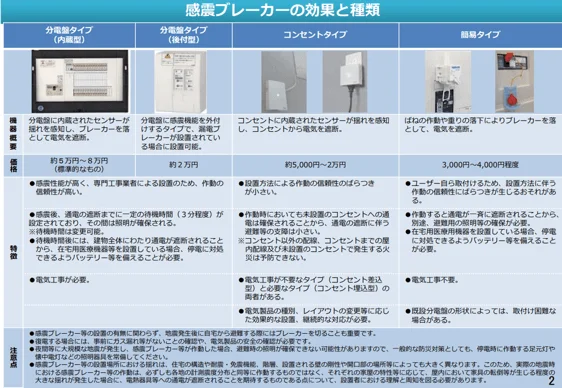
The most effective way to prevent these terrifying communal power-on fires at their root is the “earthquake-sensing breaker,” which automatically cuts off electricity when it detects a shake above a set value. However, despite its importance, government surveys indicate that the current installation rate remains around 20%.
With a strong sense of crisis, believing that “without this, severe fire damage from a Tokyo Inland Earthquake cannot be prevented,” the government significantly raised the target for earthquake-sensing breakers in this basic plan revision to “widespread installation” (a state where it is broadly implemented throughout society).
Moving beyond mere “recommendation,” it is expected that national and local government efforts for widespread public awareness and enhanced support measures will further accelerate. This means earthquake-sensing breakers are transitioning from being “for those with high disaster prevention awareness” to becoming a “common standard (infrastructure)” for all homes.
3. “I Rent,” “Too Expensive” Are Misconceptions! How to Choose for Your Home
The reason for the stalled 20% installation rate was due to common misconceptions among residents, such as “it seems like major construction is needed,” “I can’t install it in a rental property,” or “it must cost tens of thousands of yen.”
Currently, many products are available that do not require construction and can be purchased for a few thousand yen. Please choose the optimal one according to your living situation.
4. Seriousness of National and Local Governments – “Virtually Zero Cost” with Subsidies
With the government shifting its focus to “widespread installation,” local municipalities are also seriously stepping up their support. Many cities and towns currently offer subsidies for the introduction of earthquake-sensing breakers or provide simple types for free. If you are concerned about the cost of purchasing one, first search on your smartphone for “[Your City/Town Name] + earthquake-sensing breaker + subsidy.” It is not uncommon for regions where simple types costing a few thousand yen can be introduced with virtually no out-of-pocket expense.
Conclusion: To Avoid Becoming a Perpetrator in an Emergency
In the event of a major earthquake, cutting off electricity is as essential as stocking water to protect lives and assets. Moreover, to prevent the risk of your own home igniting and burning down neighboring homes or the entire community, taking measures in each household is urgent.
With the government now seriously committed to widespread adoption, there is no time to postpone with “I’ll do it later.” To prevent the tragedy of safely evacuating an earthquake only to have your home completely burned down days later, why not start by checking the location of your home’s distribution board (breaker) this weekend and begin with what measures you can take?