
Market Size and Five-Year Outlook: Efficiency Drives Growth
The global IPM market has already achieved a certain level of penetration, particularly in inverter drives for home appliances. However, the nature of demand is shifting from mere volume expansion to structural growth, emphasizing efficiency, mounting density, and reduced development times.
Key drivers for this growth include the continued inverterization, high efficiency, and miniaturization in home appliances and HVAC systems. IPMs integrate power elements, drive circuits, and protection functions, contributing to shorter development cycles, reduced board space, and improved quality stability for home appliances. As energy efficiency regulations and noise reduction requirements intensify, improving motor drive performance becomes a critical factor for product differentiation among finished product manufacturers.
Simultaneously, the adoption of IPMs is expanding into applications demanding higher efficiency and reliability in power conversion, such as industrial automation, variable-speed drives, automotive electric compressors, and thermal management systems. While IGBT-IPMs remain central to the mass market, MOSFET-IPMs are expected to see increased adoption in low-to-medium output high-frequency drives, and SiC-IPMs and GaN-IPMs in high-efficiency and high-power-density applications.
Leading Companies and Market Share
In 2025, the top 10 companies held approximately 86.0% of the global IPM market revenue, indicating a concentrated yet competitive landscape. Key manufacturers include Mitsubishi Electric, Hangzhou Silan Microelectronics, Sanken Electric, Fuji Electric, onsemi, Infineon, Rohm, China Resources Microelectronics Limited, STMicroelectronics N.V., and Semikron Danfoss.
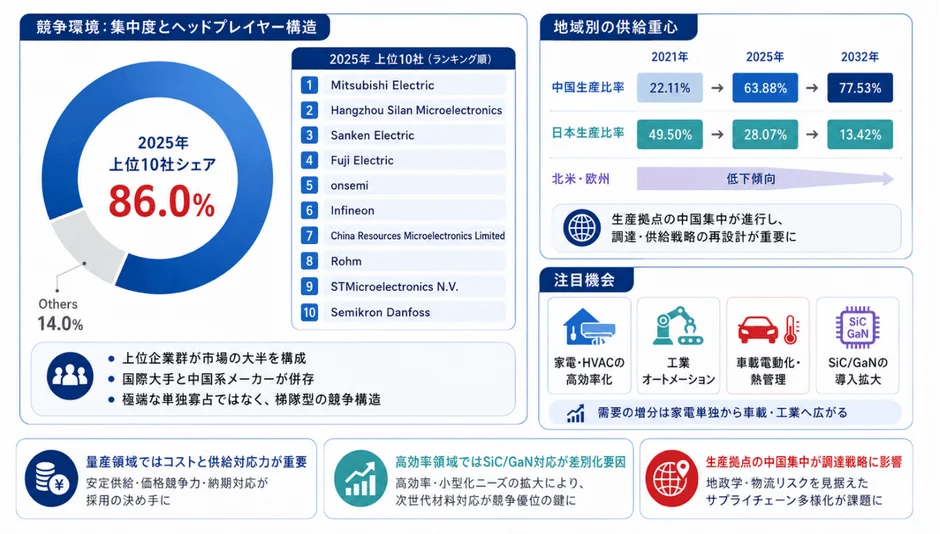
This structure suggests that leading companies exert significant influence in terms of supply, technology, and customer base. However, it is not an extreme single-player oligopoly. The growing presence of Chinese manufacturers like Hangzhou Silan Microelectronics and China Resources Microelectronics Limited, alongside established Japanese and European/American giants such as Mitsubishi Electric, contributes to dynamic competition. In mass-produced IPMs for home appliances, cost competitiveness, supply responsiveness, and customer proximity are crucial factors influencing market positions. Future competition will likely involve not just price, but also the breadth of product portfolios combining IGBT, MOSFET, SiC, and GaN for specific applications.
Recent Developments from Key Players
-
March 2025: onsemi introduced its SPM 31 IPM, targeting applications beyond traditional home appliances, such as heat pumps, servos, robots, variable frequency drives, and industrial pumps/fans. This indicates a trend towards broader industrial and high-efficiency infrastructure applications for IPMs.
-
April 2025: Mitsubishi Electric showcased full SiC and hybrid SiC samples at PCIM 2025 in Germany. Their product strategy focuses on energy-saving applications for home appliances, ranging from small to large capacities, signaling a shift from conventional silicon-based IPMs to high-efficiency IPMs.
-
January 2026: Sanken Electric and Minebea Power Semiconductor Device agreed to a technical partnership in the consumer and industrial power module business. This collaboration, centered on joint development and post-process production cooperation, aims to enhance supply capabilities and shorten development periods.
Future Outlook
Looking ahead, the importance of Asia’s production base, particularly China, is expected to grow further in the IPM market. China’s share in production is rising, and the robustness of local supply chains will directly impact competitiveness, driven by mass production demands for home appliances, industrial equipment, and automotive thermal management. Meanwhile, companies in Japan, Europe, and North America will likely differentiate themselves through high-reliability applications, SiC/GaN compatibility, and quality management for automotive and industrial sectors.
While home appliances will remain the largest foundational segment, incremental demand is shifting towards factory automation, HVAC, automotive electrification, and thermal management systems. The market is expected to feature both concentrated and diversified areas of competition. In mass-produced IGBT-IPMs, scale and cost will be critical, whereas for SiC-IPMs and GaN-IPMs, thermal design, drive control, packaging, and collaborative design capabilities with customers will be central to company evaluation.
Implications for Japanese Companies
For Japanese companies, global IPM market trends offer critical insights for product design, supply chain management, and international business strategies. Companies considering new ventures or market entry should evaluate incremental applications such as industrial drives, HVAC, and automotive thermal management, in addition to existing home appliance markets. Regarding procurement and technical partnerships, it is crucial to compare not only existing major players but also Chinese mass production manufacturers, SiC/GaN-compatible companies, and partners strong in post-processing.
Competitive analysis should continuously track not only top companies’ market shares but also their product generations, regional production, and application-specific customer bases. For investment evaluation and internal decision-making, combining market size, concentration, application shifts, and technology roadmaps will provide more practical supporting information.
For more detailed information, please refer to the full report:
Intelligent Power Module (IPM) Report Details and Free Sample Request