Understanding USB PD Controllers
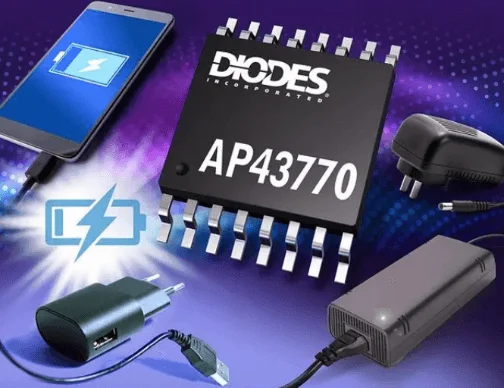
A USB PD controller is a semiconductor device designed for power management. It facilitates the negotiation and control of power supply through the USB Type-C interface, adhering to the USB Power Delivery (USB PD) standard. These controllers enable high-output power delivery, up to 100W and beyond, serving as a core integrated circuit for fast charging various electronic devices such as smartphones, tablets, laptops, and displays. A key characteristic of USB PD controllers is their ability to adjust voltage and current conditions in real-time between devices, ensuring both safety and efficiency in power supply. With the increasing prevalence of USB Type-C, there is a growing trend towards an “all-in-one interface” that integrates charging, data transfer, and video output through a single port.

Market Growth Projections
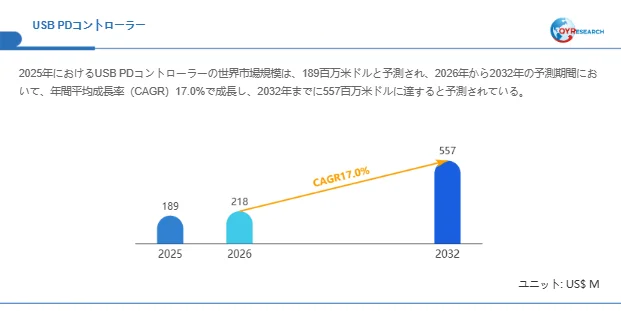
According to the latest research, the global market size for USB PD controllers is estimated at US$189 million in 2025. This market is projected to expand significantly to US$557 million by 2032, demonstrating a robust Compound Annual Growth Rate (CAGR) of 17.0% from 2026 to 2032.
Key Drivers of Market Expansion
The growth of the USB PD controller market is largely attributed to the enhanced performance and surging power demands of electronic devices. Notably, the simultaneous advancements in making laptops lighter, thinner, and more powerful have accelerated the shift from traditional proprietary power adapters to USB PD compatible charging. Similarly, the standardization of fast charging protocols in smartphones has led to an increased adoption rate of USB PD controllers. Recent trends indicate a notable rise in devices integrating USB4 and Thunderbolt, which fuels the demand for single-port solutions that combine high-bandwidth communication with power delivery.
Technological Evolution
USB PD controllers are evolving in three primary directions: enhanced efficiency, miniaturization, and multi-function integration. Improving power conversion efficiency is crucial for suppressing heat generation and reducing energy loss. Miniaturization is progressing rapidly to facilitate integration into compact devices such as smartphones and wearables. Furthermore, there is an acceleration in the development of multi-protocol integrated circuits that combine USB PD functionality with Type-C Alt Mode, DisplayPort, and Thunderbolt control. This evolution transforms USB PD controllers from mere power control ICs into system-integrated interface ICs.
Regional Market Dynamics
The Asia Pacific market stands as the largest production and consumption hub for USB PD controllers. China, in particular, is experiencing a rapid surge in demand due to its concentrated smartphone, charger, and PC industries. Conversely, North American and European markets are seeing increased adoption of USB PD controllers for high-performance laptops and industrial applications. In recent years, India and Southeast Asia have also witnessed a significant rise in demand for cost-effective USB PD solutions, driven by the widespread penetration of smart devices.
Competitive Landscape
The USB PD controller market is primarily led by global semiconductor giants such as Infineon Technologies, Texas Instruments, NXP Semiconductors, STMicroelectronics, Renesas, and Microchip Technology. Chinese manufacturers like Chipsea Tech Shenzhen and Leadtrend Tech. Corp. are rapidly expanding their market share. As of 2024, the top 10 companies globally account for approximately 64.0% of sales, indicating a relatively high concentration. However, the expansion of the USB PD standard is also encouraging new entrants into the market.
Future Outlook
Key technological themes for the future USB PD controller market include higher power output (up to 240W support), multi-protocol integration, and low power consumption designs. The proliferation of AI PCs, mobile workstations, and AR/VR devices is expected to rapidly increase the demand for sophisticated power management. Moreover, as integration with GaN (Gallium Nitride) power supply technology advances, USB PD controllers are anticipated to become central components in next-generation smart power ecosystems, leading to further market expansion.
This article is based on the report “USB PD Controller – Global Market Share and Ranking, Overall Sales and Demand Forecast, 2026-2032” published by QY Research.
For more details and to obtain a free sample of the report, please visit:
https://www.qyresearch.co.jp/reports/1626493/usb-pd-controller